Participant Voices: Personal Stories from the Food Sovereignty Movement
"Nine young people from Bandung share how the FOODS training transformed their relationship with food, community, and their power to create change—in their own words and images."

Bandung, February 2025 — Before the Food System Diplomacy School opened on 19 February 2025, participants were asked to submit a "Foods Buku" (Food Book) documenting their own food experiences through photos and, for some, essays.
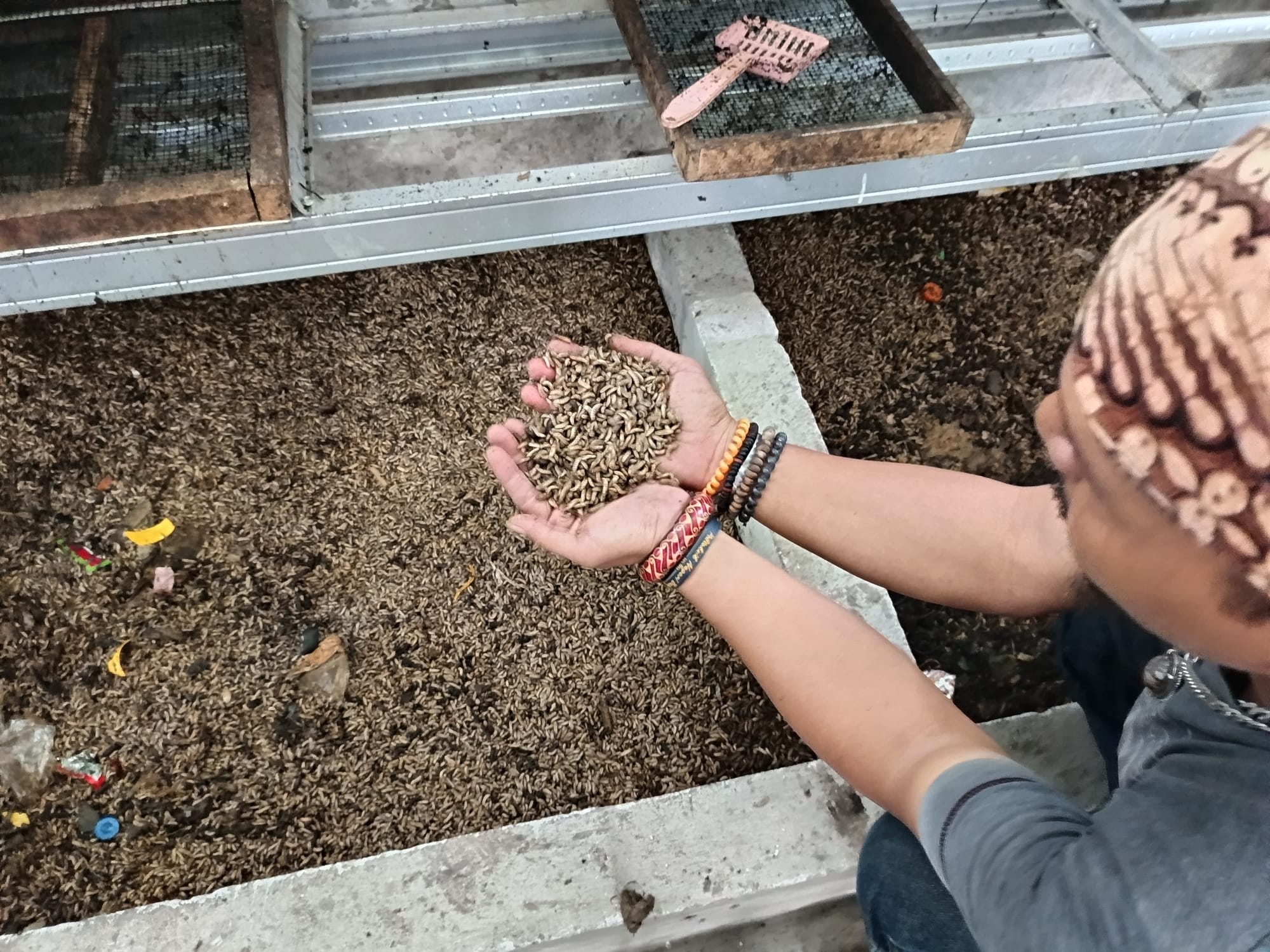
FOODS training participants documenting their food system experiences
Ten participants submitted material; two of them, Anindita and Windi Hefitriani, wrote essays, and the others sent photographs. These voices, representing diverse experiences across disability, gender, and economic status, offer a ground-level view of food sovereignty in action.
Anindita: From Food Waste to Food Justice
Anindita, a 2024/2025 environmental engineering student at Winaya Mukti University, came to the FOODS training with existing commitments to environmental justice. Active in youth organizations like Pemuda Peduli Lingkungan Asli dan Bersih (Youth Care for Clean Native Environment) and YOS Indonesia, she had already connected environmental degradation to food systems through her community service work.
"My interest in sustainable food systems deepened during community service in Pakemitan subdistrict, Cinambo, Bandung," Anindita wrote in her Foods Buku essay. The project, a collaboration between the Environment and Forestry Agency, regional higher education coordination, and private universities, exposed her to household food waste patterns.
What struck Anindita was the disconnect: some residents understood organic waste management, using maggot farming and ecoenzyme production to convert food scraps into resources. But many others remained unaware of how household food waste contributes to landfill methane emissions and environmental pollution.
Her essay argues that a sustainable food system must cover not only production and distribution but also responsible consumption and better post-consumption management. Her participant photos documented Pakemitan's community composting initiatives, showing practical food waste solutions already working at grassroots level.
Anindita's takeaway: "Change can start with small actions done consistently. Simple steps like public education and environmentally friendly technology can create major impacts toward sustainable food systems. With strong collaboration between government, academics, and communities, Bandung can become an example of a city with more inclusive, environmentally friendly food systems."
Windi Hefitriani: A Food System for Everyone
Windi Hefitriani, who describes herself as a person with a disability, wrote about a food system that is still not inclusive for people with disabilities.
She called for food outlets designed for access, such as wide paths, automatic doors and accessible ordering systems, and for food-processing tools usable with one hand or with large buttons, so that people with disabilities can take an active part in preparing food.
Muhammad Azmi: Defending Traditional Food Markets
Muhammad Azmi Nizar Daifulloh Wahab, a young photographer, contributed photographs of cassava being harvested, peeled and processed.
Yunita Aghniya Rahmani: In the Field
Yunita Aghniya Rahmani contributed photographs of vegetable plots and of a group visit to farm fields.
Khirania Azzhura Sentosa: Youth Organizing for Food Change
Khirania Azzhura Sentosa contributed photographs of a food bazaar, with stalls and their crews serving visitors.
Rahma Tasya: Connecting Food and Climate
Rahma Tasya contributed a photograph of herself at an outdoor café table with food and drinks.
Imanuael Ezra Prawira: Food Entrepreneurship with Justice
Imanuael Ezra Prawira came to FOODS with entrepreneurial interests. He'd been considering food businesses—a café, catering service, or food delivery platform—but hadn't thought about justice dimensions.
His Foods Buku photograph shows two men working a cleared farm field.
Marfuah and Heny Badriah: Women's Food Sovereignty
Marfuah and Heny Badriah each contributed a photograph: Marfuah a portrait taken in a meeting room, and Heny a picture of herself holding a tray of freshly baked bread.
Common Themes: From Individual to Collective
Across these nine Food Books, common patterns emerge. Participants moved from:
- Fragmented awareness to systems thinking: Connecting food waste to climate, markets to policy, personal choices to structural forces
- Passive consumption to active agency: Seeing themselves as shapers of food systems, not just recipients
- Individual struggles to collective power: Recognizing shared challenges and organizing together
- Skills to action: Converting training content into concrete projects in their communities
The Foods Buku assignment itself was pedagogically significant. By asking participants to document and reflect, the training validated their experiences as knowledge. It positioned them as experts of their own realities, not just students absorbing information.
The Power of Story
These nine stories matter because food systems theory without human faces risks abstraction. Statistics about food insecurity or agricultural productivity don't capture the texture of daily life—the negotiations, adaptations, and quiet resistance that constitute food sovereignty from below.
Large-scale food system change happens through accumulation of small shifts: one person starting a garden, one community forming a cooperative, one advocate winning a policy concession. The FOODS training equipped fifty participants with the understanding, skills, and networks to make those shifts.
Their voices, documented in the Foods Buku collection, testify to education's transformative potential when it centers learners' experiences, validates their knowledge, and supports them to act.
The Foods Buku (Food Book) participant reflections were submitted as part of the Food System Diplomacy Training designed and delivered by CRPG for the PESPA Consortium (led by Article33, funded by Yayasan Humanis dan Inovasi Sosial) in February 2025. Participant names are shared with permission.
Correction (27 September 2026): this post was checked against the primary sources and corrected. What changed: Submissions are dated 16 Feb 2025, three days before the school opened on 19 Feb 2025; Ten participants submitted; only two (Anindita, Windi) wrote essays, both before the training; the rest sent photos only; Windi's essay is about disability-inclusive food systems, not urban agriculture; Essay (pre-training) concerns disability inclusion in food systems; Essay asks for accessible shops and restaurants (wide access, automatic doors, accessible ordering) and adapted food-processing tools; Her submission contains one portrait photo, sent before the training; No such text in her essay; No source; her essay states she wants to help develop technology and training for people with disabilities in urban farming or food processing; Azmi's photos show cassava harvesting and processing ("ekspedisi pahlawan"), not markets; folder holds photos only, no written text; photos show cassava, not commerce. Also: 23 further corrections of the same kind and 6 minor corrections of detail. Report errors to contact@crpg.id.