Using AI skills to conduct a water tenure analysis
CRPG has published an open-source pack of AI agent skills that turns scattered evidence into a source-cited inventory of water tenure arrangements. This article explains the steps, the safeguards, what a run produced, and what the skills do not replace.

Water tenure is "the relationship, whether legally or customarily defined, between people, as individuals or groups, with respect to water resources" (FAO 2016). A water tenure assessment sets out who actually uses water, where, and on what terms. The answer is often different from what the permit register says.
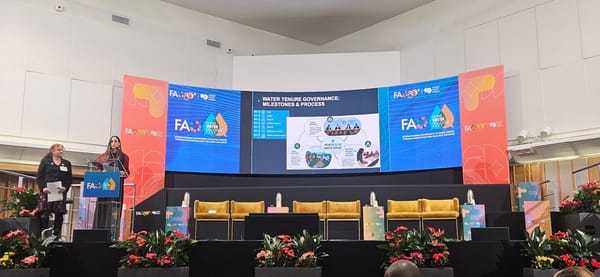
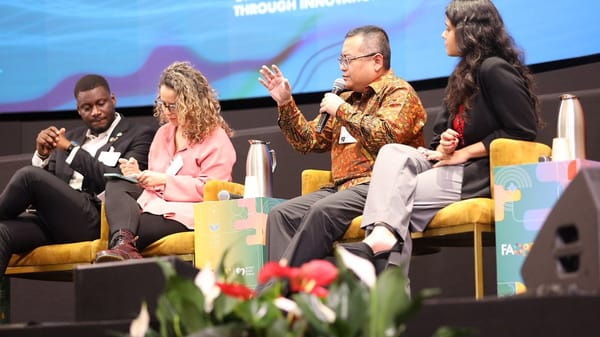
CRPG's director, Mohamad Mova Al'Afghani, a member of the FAO Water Tenure Expert Group, spoke this week at the Rome Water Dialogue 2026 at FAO headquarters, where FAO presented its draft principles for the responsible governance of water tenure. We have published the tools we use for this work so that other teams can run the same kind of analysis and check it.
Why desk-based tenure analysis is hard
Most assessments begin at a desk with whatever has been written down: interview and FGD transcripts, field notes, permit registers, archives, news reports, NGO documents and journal papers. The sources are scattered, they use local terms, and they rarely agree. Three problems recur.
- Law and practice diverge. A permit register shows who is licensed, not who draws the water.
- Some users hardly appear in the record: women, tenants, tail-end farmers, fishers. They show up in a stray sentence of a transcript, or not at all.
- Claims lose their trail. A figure that appears in three reports may trace back to one of them, and nobody can say which.
What the skills do
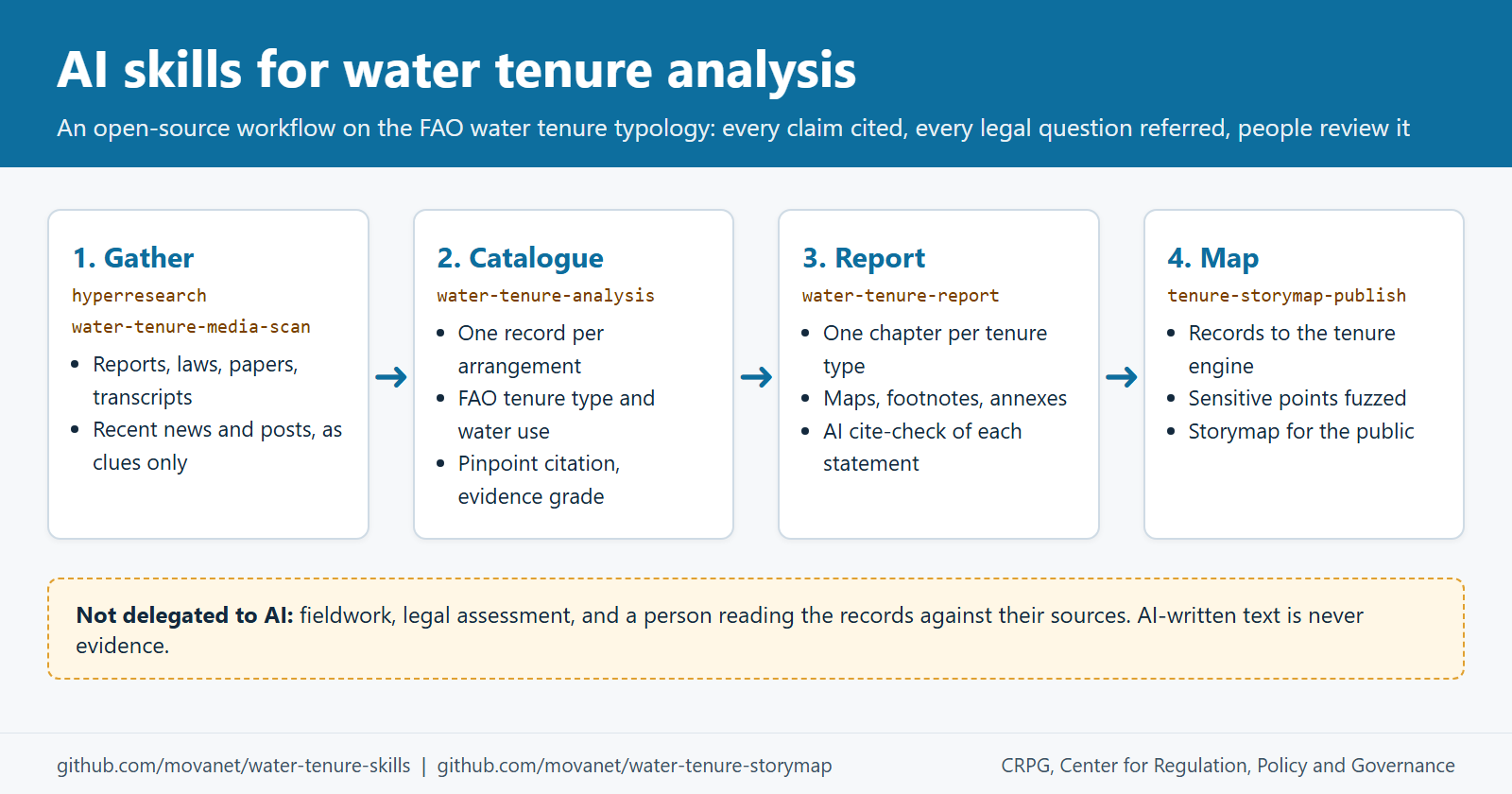
water-tenure-skills is a pack of Agent Skills for Claude Code. A skill is a folder with a SKILL.md file of plain-text instructions, so other coding agents that read the format can use the same folders. The core skill, water-tenure-analysis, turns scattered evidence into a source-cited inventory of tenure arrangements: who uses which water, where, and how. It works through these steps.
- Register the sources and read them.
- Extract each arrangement as a catalogue entry.
- Classify it on the FAO water tenure typology, for example agency control, commonhold, de minimis, customary, informal, assumed, impossible or unrecognised.
- Code the water uses.
- Look on purpose for the users the sources skip.
- Locate the arrangement by administrative unit and by its place in the river system.
- Grade confidence by how many independent sources agree.
- Attach a pinpoint to every claim: a page, paragraph or timestamp that a reviewer can open and check.
A checker script then validates the finished catalogue before anything is built from it.
Five more skills sit around the core. water-tenure-assessment runs the whole workflow from start to finish. water-tenure-report builds a long-form report organised by FAO tenure type, with footnotes, maps, annexes and a docx build. water-tenure-media-scan scans recent news and social media for a basin with the open-source last30days skill; social media counts as a clue only, and every figure is re-verified. water-tenure-hyperresearch drives the open-source hyperresearch deep-research pipeline to build the catalogue. tenure-storymap-publish pushes a catalogue to the storymap engine.
The method draws on CRPG's water tenure assessment experience, FAO's water tenure assessment guidance and its publications Exploring the Concept of Water Tenure (2016), Unpacking Water Tenure for Improved Food Security and Sustainable Development (2020) and Water Tenure Perspectives (2024), and AlAfghani, Lee and Yasuda (2025) in the Journal of Energy & Natural Resources Law.
Safeguards
An AI agent reads fast and writes fluently, so it can produce a tidy catalogue that is wrong. The skills are written around that risk. We would rather publish an entry with a low confidence grade than one that sounds sure and cannot be checked.
- Every claim carries a pinpoint that a reviewer can check against the source.
- Confidence is graded by triangulation. A single source earns a low grade, however sure it sounds.
- AI-generated material is never evidence. The agent can read, sort and draft, but it cannot be the source of a fact.
- Legal questions are flagged for a separate legal assessment. The skills never answer them.
- Output is labelled as draft, and the workflow expects a person to review the catalogue before anyone relies on it.
- Informants are protected. When a catalogue goes to the storymap, names are left out and sensitive points are fuzzed.
What a run produced
In early October 2026 we used the skills for an AI-assisted desk review of water tenure in an Indonesian river basin, done for a research consortium. The result is a long desk review with a separate annex volume, now in review. It is organised by the FAO tenure types. Every footnoted statement was read by an AI cite-checker against the source it cites, and an annex records how AI was used and where each part came from.
Three limits go with it. It was a desk review, so there was no fieldwork. It is an unreviewed draft, and human review is still pending. And AI cite-checking is a screen, not a substitute for a human reader. We are not naming the basin or the client, and we are not publishing findings, until that review is done. The point here is the process.
What it does not replace
A desk review cannot see an arrangement that nobody has written down. That takes fieldwork, and the skills do not do it. Whether an arrangement is lawful or protected is a legal question for lawyers working from the statutes and the case law. What a catalogue means for a particular community is a judgement for the people closest to the water, and for the officials and reviewers who answer to them. The skills give you a structured starting point that others can check. The conclusions are still yours.
Try it
You need Claude Code. Install the pack with two commands.
/plugin marketplace add movanet/water-tenure-skills
/plugin install water-tenure-skills@water-tenure-skills
Start with the synthetic example in the repository, which is invented and set in a fictional area, and run the catalogue checker on it before you point the skills at real sources. hyperresearch and last30days are separate open-source projects with their own licences; install them only if you want the skills that use them. The repository is MIT licensed: github.com/movanet/water-tenure-skills.
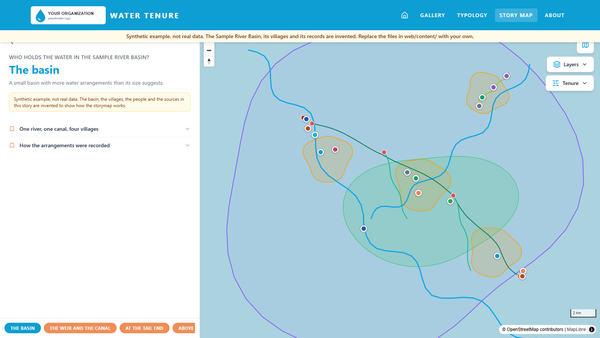
To see where a catalogue ends up, open the live storymap at tenure.crpg.info. Its software is also open source at github.com/movanet/water-tenure-storymap. CRPG also keeps an Indonesian-language water tenure knowledge base at github.com/movanet/know-crpg-tenur.
How this was made
The skills were vibe-coded. The instructions, scripts and documentation were written by AI coding agents (Claude Code with Anthropic Claude models, operated as CRPG's agent "Mobot") under the orchestration of Mohamad Mova Al'Afghani, who set the goals, the method and the domain rules and directed and reviewed the work. Treat the pack as research software: review it before relying on it.
How to cite
If you use the skills in a report or paper, please cite them. The repository also carries a CITATION.cff file.
Al'Afghani, M. M. (2026). Water Tenure Skills (Version 1.0.0) [Computer software; vibe-coded with AI agents, orchestrated by the author]. CRPG. https://github.com/movanet/water-tenure-skills
AI disclosure: this article was drafted by Mobot, CRPG's AI agent, under the direction of Mohamad Mova Al'Afghani, and is published under his direction.