FAO presents draft principles for the responsible governance of water tenure in Rome
A global consultation reaching 768 participants in 95 countries has shaped 12 draft principles on water tenure. Fair and inclusive allocation emerged as the shared priority.

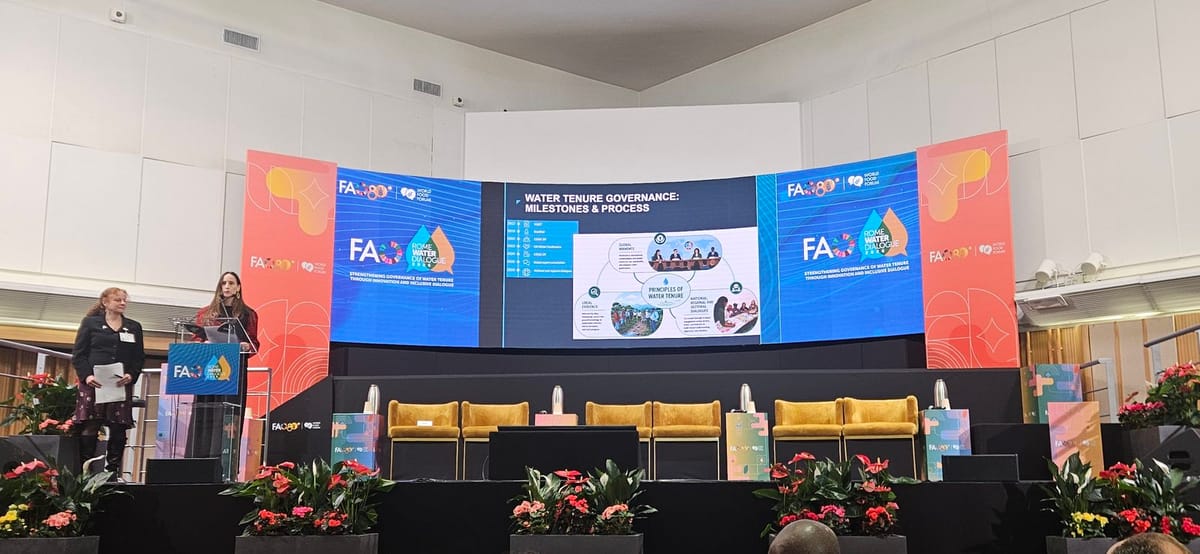
Rome, 12 October 2026. Water tenure was the theme of the first technical session of the FAO Rome Water Dialogue 2026, held at FAO headquarters during World Food Forum week. The session, organised by FAO's Land and Water Division, presented the draft Principles for the Responsible Governance of Water Tenure, the result of a global dialogue that FAO launched at the UN 2023 Water Conference in New York.
Lifeng Li, Director of FAO's Land and Water Division, framed the session in a single line: "the water crisis is a crisis of governance." Managing water well, the Director said, requires clear decisions on who can access water, how much they can use, for what purpose and under which conditions. Clarity on those questions reduces conflict, builds trust and gives farmers, communities and the public and private sectors the confidence to invest.
Two tools, one picture
In the keynote, Benjamin Kiersch, Senior Water Resources Specialist in FAO's Land and Water Division, presented two complementary tools. Water accounting covers the physical side: how much water is available, allocated and consumed, and what ecosystems need. Water tenure assessment covers the governance side: who uses water, under which formal, informal or customary arrangements, and how secure those arrangements are. Water tenure, Kiersch stressed, is not about ownership of water. It is about rights to access, use and manage the resource, and the duty to protect it.
An example from a basin in northern Colombia showed why the two belong together. Satellite data from FAO's WaPOR portal helped estimate crop water demand, which made up almost all demand in the basin. In the dry season, allocations exceeded the water available. Groundwater, Kiersch noted, is still missing from most water balances, and an incomplete balance can undermine small farmers' security of access even where they hold formal rights.
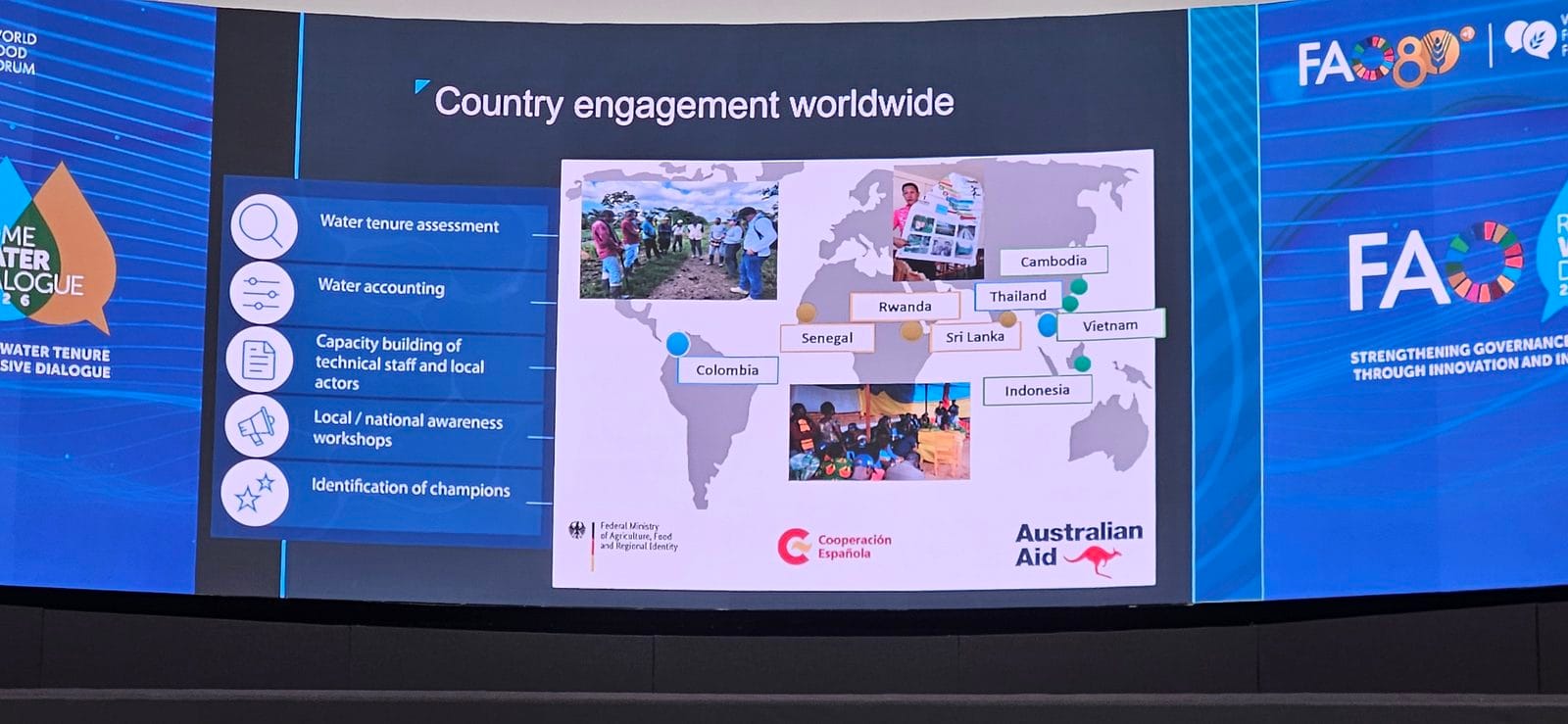
FAO has applied the assessment in Colombia, Senegal, Rwanda, Sri Lanka, Thailand, Cambodia, Viet Nam and Indonesia, with support from Germany, Australia, Spain and the Netherlands. The common findings are sobering. Customary tenure has weak or no recognition in formal law. Difficult access to permits and concessions weakens water security. Ecosystem needs and non-consumptive uses such as fisheries are poorly integrated into planning and allocation. One positive finding stood out: the assessment process itself empowers local water users and builds their capacity.
What 768 participants said
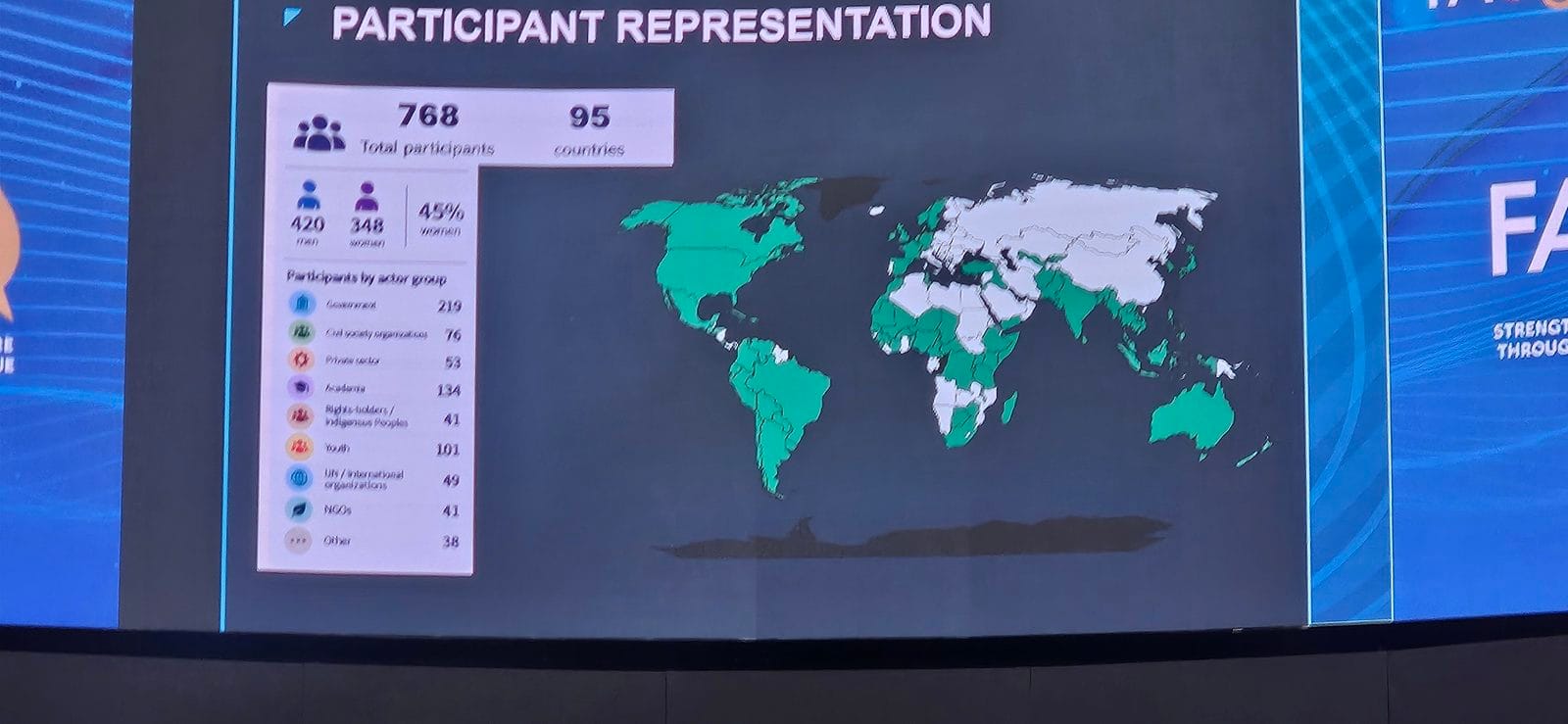
Sofia Espinosa Flor, Land and Water Tenure Specialist at FAO, and Jessica Troell, Director of the International Water Programme at the Environmental Law Institute, then presented the results of the consultations. Regional dialogues for Asia-Pacific and for Latin America and the Caribbean, national dialogues in Thailand, Colombia and Senegal, and sectoral consultations with academia, civil society and rights holders, and youth reached 768 participants from 95 countries, 45 per cent of them women.
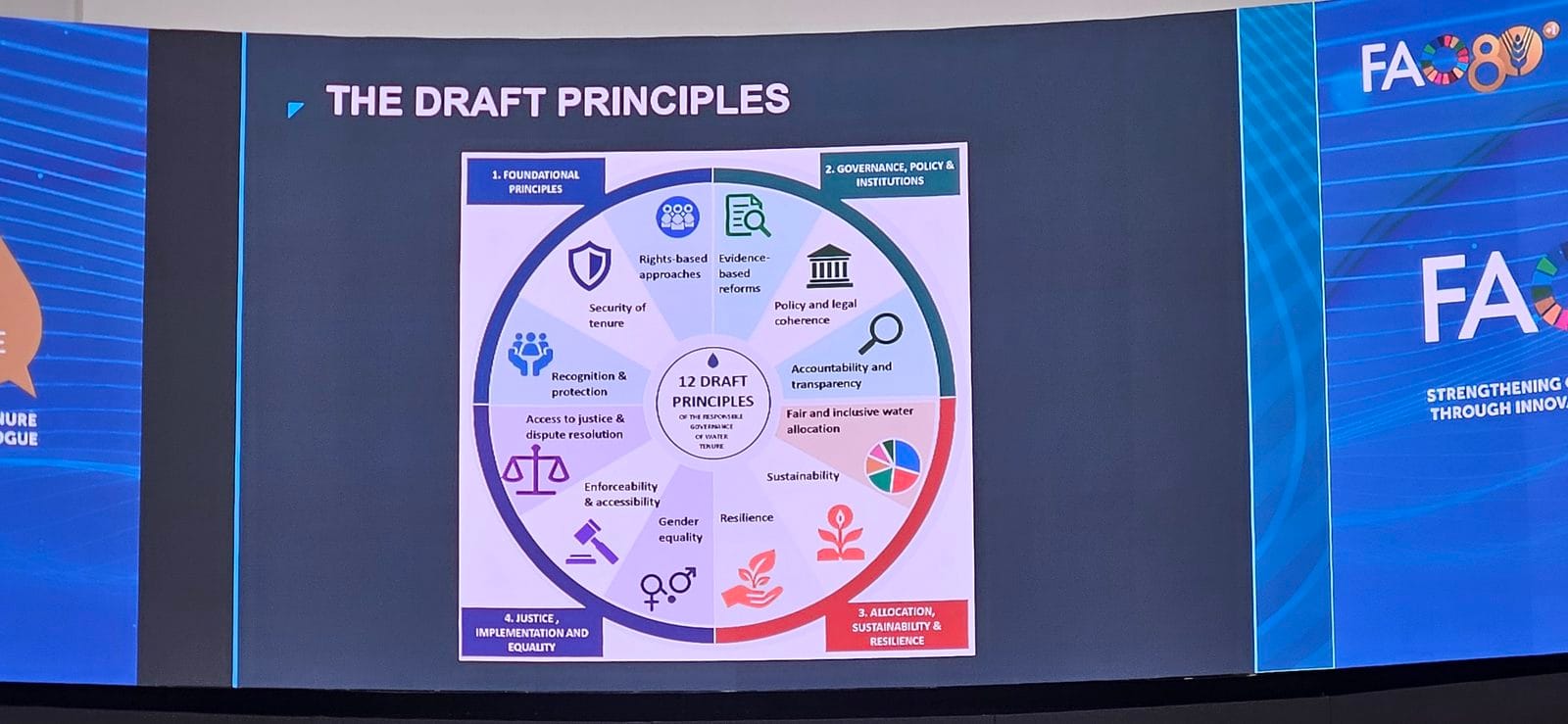
Participants agreed that all twelve draft principles are essential and interrelated. Fair and inclusive water allocation emerged as a common priority across regions and stakeholder groups; among government participants in Asia-Pacific it ranked first. Water quality was raised 48 times, under 11 of the 12 principles, and will be given more weight in the next iteration.
Several cross-cutting themes ran through the feedback. Prioritisation criteria must be clear, transparent and implementable, especially in times of scarcity. Formal licensing can unintentionally exclude small-scale users and customary systems. Data on users and on groundwater is fragmented, which leaves many small users invisible. And the gap between laws and practice remains wide. One academic participant from Asia put the climate dilemma this way: tenure must stay flexible, but "flexibility should not become insecurity for vulnerable groups."
Questions still open
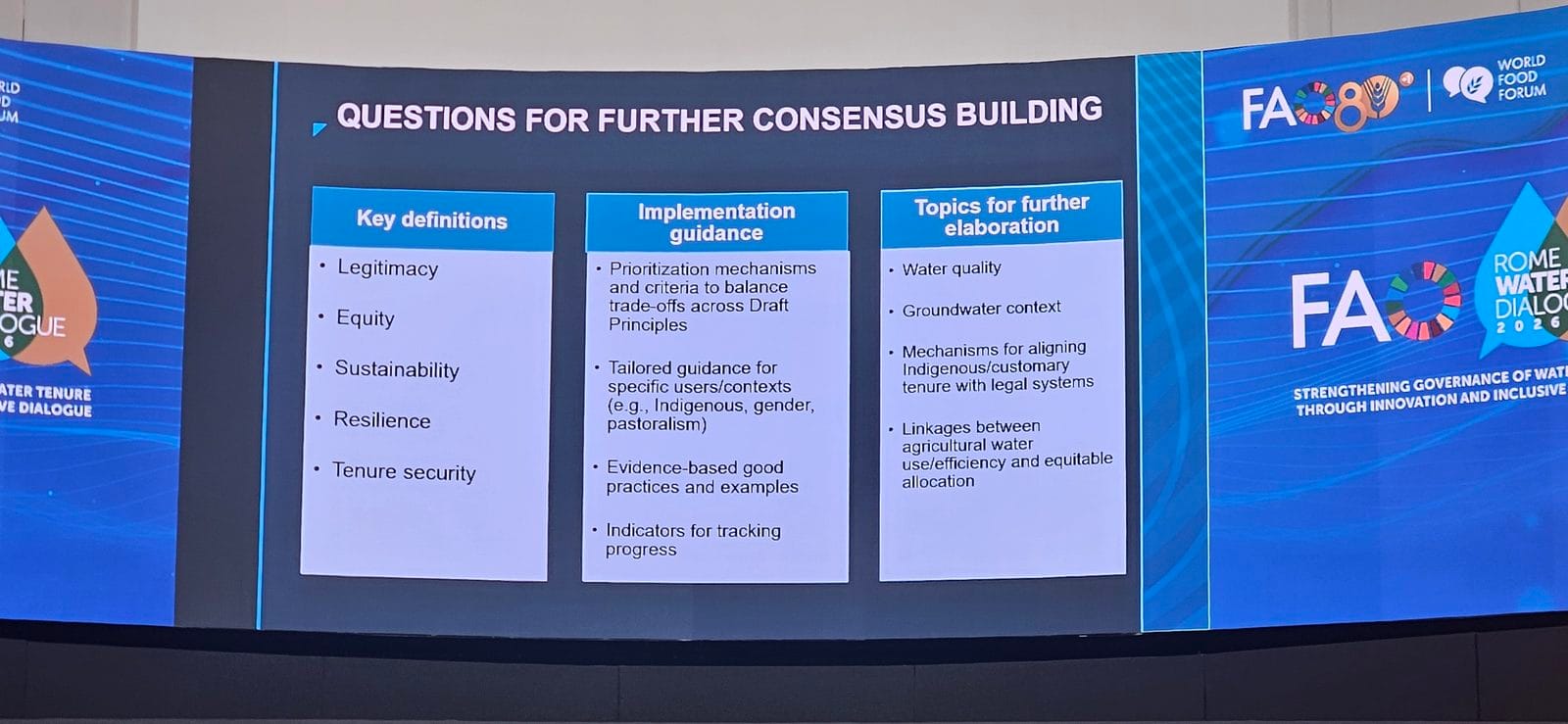
The consultations also mapped where consensus is still needed. Key concepts need shared definitions: legitimacy, equity, sustainability, resilience and tenure security. Governments asked for implementation guidance on prioritisation mechanisms, tailored guidance for Indigenous peoples, women and pastoralists, good-practice examples and indicators to track progress. Four topics need further work: water quality, groundwater, aligning Indigenous and customary tenure with legal systems, and the link between agricultural water efficiency and equitable allocation.
Voices from the panel
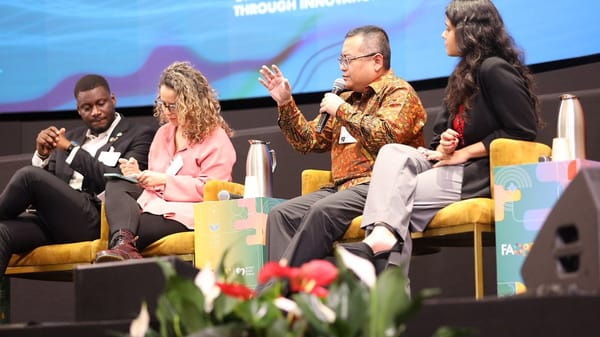
A panel moderated by Maria Alejandra Chaux Echeverri, Senior Natural Resources Specialist at FAO Colombia, then brought in the view from the ground. Daniel Mwendah M'Mailutha, President of the World Farmers' Organisation, argued that water cannot be separated from food and that farmers' own knowledge of managing water must be valued. Lamine Samaké, Land and Water Tenure Expert at FAO Senegal, who coordinated the national dialogue in Senegal and a regional consultation on pastoralism, called for recognition of pastoralists' customary and collective rights, a real voice in decisions, and investment in water infrastructure that respects pastoral mobility. Beth Sua Carvajal Martinez of WWF Colombia's Water Governance Programme described a decade-old public, private and community platform in two watersheds of northern Colombia. Tania Sharma, Land Data Specialist at FAO, reported from a global youth consultation: young people are invited to consultations but rarely given a role in the decisions.
From Indonesia, CRPG Director Mova Al'Afghani, PhD, drew on water tenure assessments to show how the method reveals water users that the formal system does not see. His contribution is covered in a separate article.
Next steps
The draft principles are now open to FAO members for further refinement. The debate continues at the high-level session of the Global Dialogue on Water Tenure on Wednesday, 14 October, 09:00 to 12:00, in the Plenary Hall at FAO headquarters. FAO has also launched an online course on the fundamentals of water tenure. Programme and recordings are on the Rome Water Dialogue 2026 event page.