We cannot manage what we cannot measure: CRPG on Indonesia's missing water account
Indonesian law already treats surface water and groundwater as one resource, CRPG told the Echelon 2 consultation on water accounting. What is missing is an institution that keeps the integrated balance, an instrument that makes data move, and a named owner.

Jakarta, 12 November 2026
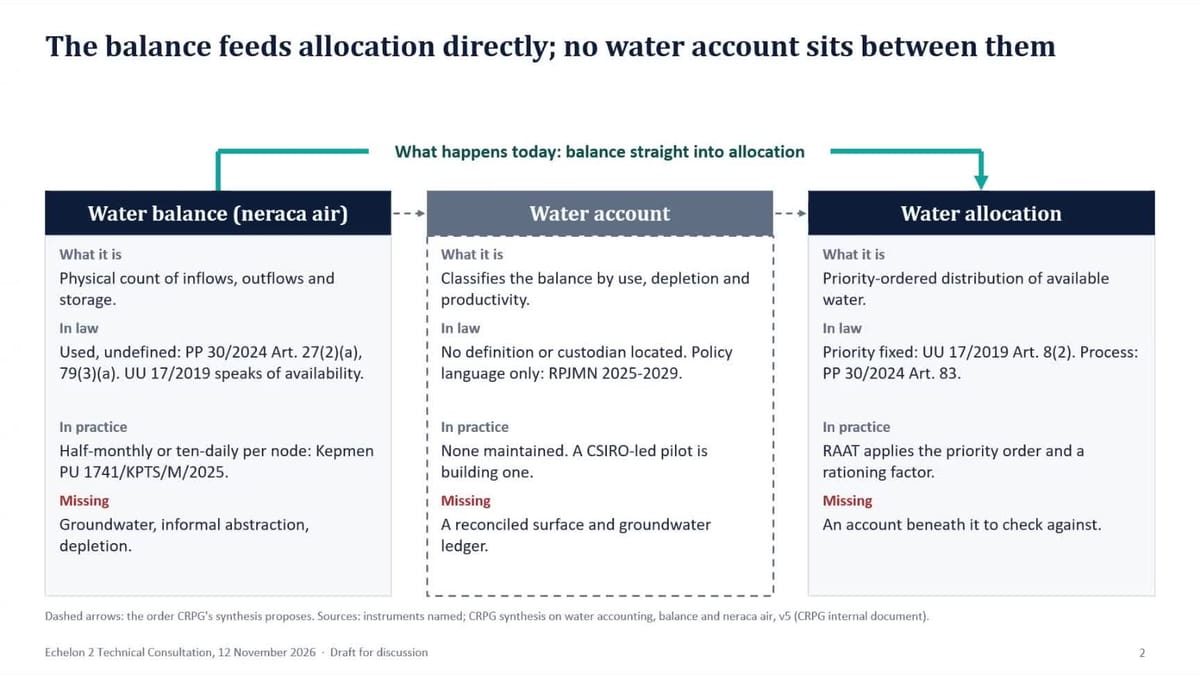
Image: CRPG's slide on the water balance, the water account and water allocation, from its presentation to the Echelon 2 consultation.
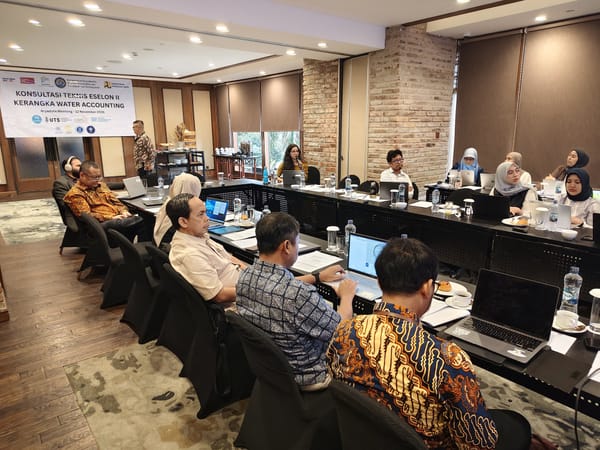
Indonesia's water law is stronger on paper than in practice. It treats surface water and groundwater as one resource and asks for one plan for each river basin. Yet no institution keeps an integrated balance of the two, the data needed to build one sit with more than a dozen custodians, and much of the groundwater actually pumped is counted by no one. That was the message CRPG Director Mova Al'Afghani brought to the director-level (Echelon 2) technical consultation on a water accounting framework, held at the Hotel Aryaduta Menteng in Jakarta on 12 November.
"We cannot manage what we cannot measure," he told the meeting, adding: "or what we cannot account." The data, he argued, will not move between ministries until a single policy makes them.
The consultation was convened by the Coordinating Ministry for Infrastructure and Regional Development (Kemenko Infra) with the project that is piloting the framework in the Progo catchment of the Serayu–Opak basin. The project is supported by the Australian Water Partnership and led by CSIRO, with Water Stewardship Indonesia, the University of Technology Sydney, Universitas Gadjah Mada, IPB University and CRPG. CRPG leads its review of water governance and institutions. The rest of the meeting, from Kemenko Infra's opening to the framework itself and the ministries' responses, is reported in a separate article.
A balance is not an account
He began with three terms the meeting would use all day. A water balance (neraca air) is a physical count of inflows, outflows and storage. It has a legal footing: Peraturan Pemerintah Nomor 30 Tahun 2024 tentang Pengelolaan Sumber Daya Air (Government Regulation 30 of 2024 on Water Resources Management, BPK) uses the term, although it does not define it. A water account goes further. It classifies the balance by use, depletion and productivity, and so records not only what is available but what was taken and by whom. CRPG located no legal definition of a water account and no custodian for one. The term appears in policy, in the national medium-term development plan (RPJMN 2025–2029), not in law.
Allocation, the third term, decides who receives what, and its order is fixed by statute. Undang-Undang Nomor 17 Tahun 2019 tentang Sumber Daya Air (Law 17 of 2019 on Water Resources, BPK) ranks basic daily needs first, people's farming second, and business use that meets daily needs through piped drinking water systems third (Pasal 8 ayat (2)). Today, he said, the balance feeds the annual allocation plan (RAAT) directly. The plan applies the priority order and a rationing factor, but there is no account beneath it against which actual use can be checked.
One resource in law, two in practice
The review's national finding, drawn from ten governance domains, was that no actual integration of surface water and groundwater is in place, despite the regulation. PP 30/2024 bases water resources management on river basin territories "including the groundwater basins" within them (Pasal 5 ayat (1) huruf b), and the plan for each basin is meant to be integrated. But the pieces sit with different institutions. The Ministry of Public Works and its river basin offices run the surface water planning cascade, from the basin strategy to the annual allocation plan. The Minister of Energy and Mineral Resources designates groundwater basins (Pasal 5 ayat (3)), while approvals to use groundwater are issued by the minister, governor or regent according to their authority (Pasal 116 ayat (1)), which on CRPG's reading follows the class of the river basin rather than the extent of the aquifer. Recharge areas fall to the forestry administration, outside both permit systems.
No one is named as owner of an integrated balance, and CRPG found no rule binding a groundwater approval to the annual surface water plan. When permits are issued, he said, they do not reflect how much surface water is available. The national water council and the basin forums coordinate and advise; they do not decide. "The duty to integrate is already in law," his slide concluded. "What is missing is the institution, the data-sharing instrument and a named owner."
Groundwater that nobody counts
Permit registers, he argued, are read as a picture of water use but are only its lower bound. Beneath them sit three layers. The first is use that the law exempts from approval: PP 30/2024 allows non-business use for individual basic daily needs, and for people's farming within irrigation systems, without an approval (Pasal 104 ayat (1)). The second is pumps and wells supplied through state programmes, including agricultural programmes, whose permit status is undocumented and which are not always coordinated with the river basin office. The third is abstraction that no one has recorded at all. The volume of these three layers has not been measured, and the ratio between registered and actual use cannot yet be calculated.
For a water account, he said, this is the gap that matters most: the unmeasured volume of informal and state-sponsored abstraction.
Data that exist but do not move
The review counted 28 types of data that a basin water account needs, from reservoirs and groundwater levels to rainfall, abstraction, recharge and water quality. Rainfall sits mainly with BMKG, water quality with the Ministry of Environment, groundwater with the Geological Agency, base maps with the Geospatial Information Agency, and pumps and wells with the energy and agriculture ministries. Several fluxes, recharge among them, have no designated custodian at all.
On CRPG's reading of the regulations, only data held on the Public Works route reach the balance directly. The rest mostly exist, but access stalls. Some data carry non-tax state revenue charges (PNBP); others are released only on conditions, or under a memorandum of understanding or cooperation agreement (PKS) negotiated case by case. There is no common policy that integrates them. His proposal was a single door for water data, so that every ministry can reach it.
The legal anchor exists. UU 17/2019 describes the water information system as a network "spread across and managed by various institutions" (Pasal 54 ayat (2)) and requires that network to be accessible to all parties concerned (Pasal 54 ayat (3)). PP 30/2024 repeats that the integrated system is a network spread across ministries, agencies and regional offices (Pasal 121 ayat (2)). In CRPG's reading the duty is to interconnect. No instrument requires the pieces to be reconciled into one ledger.
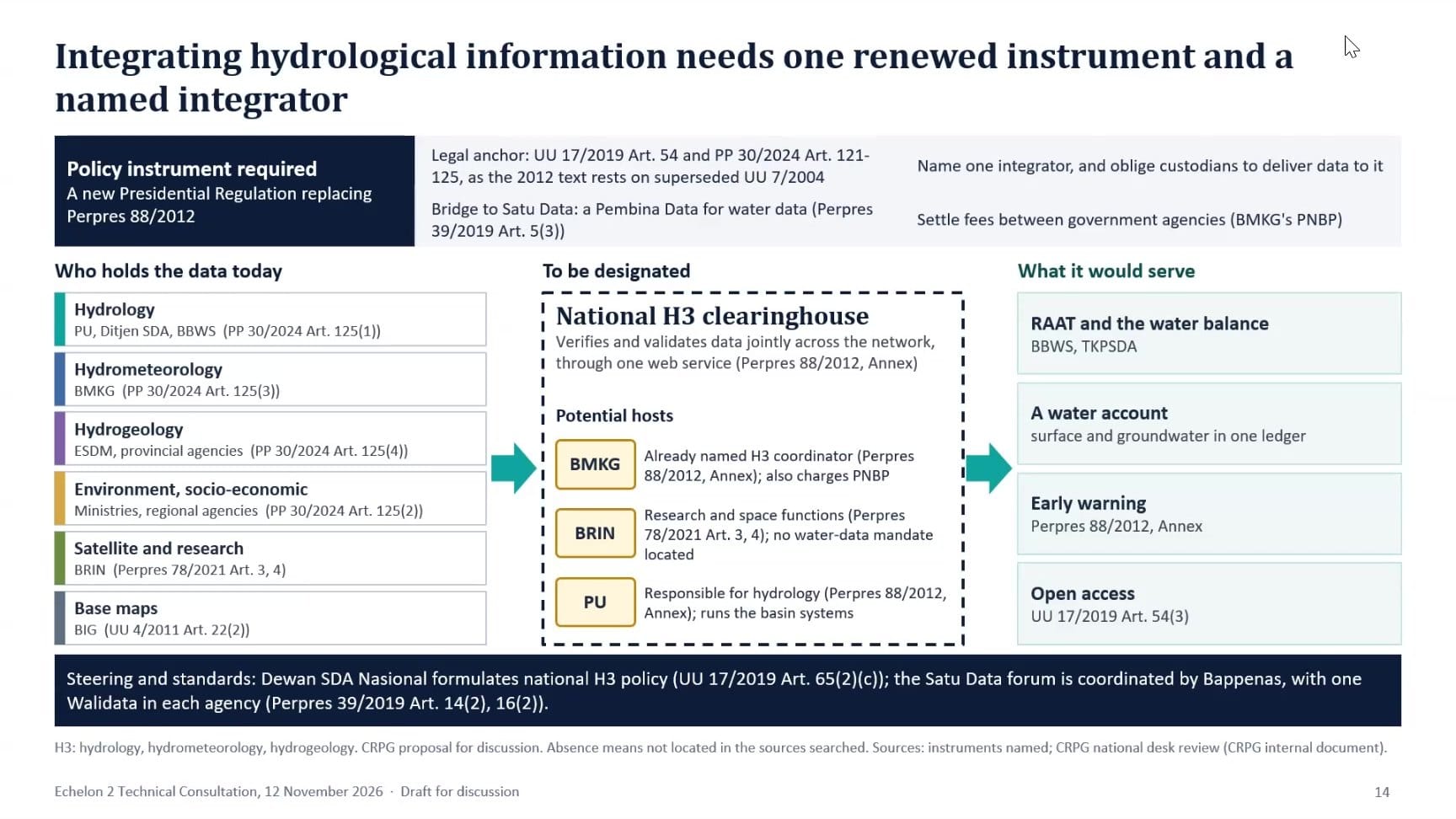
Image: CRPG's proposal for one instrument and one integrator, from its presentation.
One instrument, one integrator
The national policy on this information is Peraturan Presiden Nomor 88 Tahun 2012 tentang Kebijakan Pengelolaan Sistem Informasi Hidrologi, Hidrometeorologi, dan Hidrogeologi pada Tingkat Nasional (Presidential Regulation 88 of 2012 on the National Policy for Managing Hydrological, Hydrometeorological and Hydrogeological Information Systems, BPK). It divides the work, making Public Works responsible for hydrology, BMKG for hydrometeorology and the energy ministry for hydrogeology, and it names BMKG as national coordinator, with a clearinghouse to verify and validate data jointly. But it predates the current Water Resources Law, and it imposes no duty on custodians to deliver their data.
CRPG's recommendation, offered for discussion, is a new Presidential Regulation to replace it, anchored on UU 17/2019 Pasal 54 and PP 30/2024 Pasal 121 to 125. It would name one integrator and oblige each data custodian to deliver to it; run a national clearinghouse that verifies and validates data jointly; settle fees between government agencies; and link water data to the One Data Indonesia framework. The same clearinghouse would serve the annual allocation plan and the water balance, a water account that holds surface water and groundwater in one ledger, flood early warning, and open access. BMKG, BRIN and the Ministry of Public Works were set out as potential hosts, each with its own strengths and gaps.
He pointed to Thailand. After the 2011 floods exposed how poorly its water data were integrated, Thailand built a national hydro-informatics institute that, on its own figures, now links 54 agencies across 12 ministries and 435 datasets. An Indonesian delegation visited it in December 2025 under a programme facilitated by FAO. Indonesia, he said, has nothing like it yet.
Responding for Kemenko Infra, Suraji, its Assistant Deputy for Water Resources and Food Infrastructure, noted that the National Water Resources Council is chaired by the Coordinating Minister for Infrastructure. An integrated platform could be hosted through the coordinating ministry, he indicated, with each agency's data custodians feeding it, and a policy on the hydrological information system was expected to be issued next year.
Tenure changes what an account must record
The review also covered water tenure. A desktop assessment, built with AI tools from documents and press reports and classified against the FAO tenure typology, found agency-controlled infrastructure and collective arrangements, such as rotation among water user associations at a weir, alongside many arrangements that are informal and not recorded in any register. For the account, the slide drew three consequences: record tenure for each abstraction, keep "paper water" and "wet water" apart, and count users who hold no permit.
Two emerging issues will change what an allocation plan must weigh. The first is a proposal under discussion for the draft Drinking Water and Sanitation Law (RUU PAMS) to move utility supply for basic needs above people's farming in the priority order. It is a proposal, not law and not a government position; he expected the House of Representatives to take up the bill next year.
The second is already law. Undang-Undang Nomor 10 Tahun 2026 tentang Pengaturan Reforma Agraria (Law 10 of 2026 on Agrarian Reform, BPK; background at know.crpg.id), in force since 30 September 2026, states that the people's right to water is kepemilikan bersama, joint ownership, to obtain and use water, springs and water areas (Pasal 20 ayat (3)). The Water Resources Law says the opposite: the people's right to water "is not a right of ownership of water", only a right to obtain and use a quota (UU 17/2019 Pasal 8 ayat (7)). Because springs can now become objects of agrarian reform, and the body that will register those rights has not yet been formed, he urged the ministries concerned to align the water and agrarian regimes while the implementing rules are drafted. Otherwise, permits issued under one regime may collide with rights granted under the other.
Co-production instead of case-by-case agreements
Late in the discussion he returned to data exchange, building on BMKG's account of co-producing information with partners. If a regulation mandated a national water account, with each ministry's share of the data spelled out, could that single instrument replace the cooperation agreements now negotiated one by one? The Directorate General of Water Resources replied that a water balance guideline is being drafted for issue next year. CSIRO's Sreekanth Janardhanan agreed that integration may mean revising existing mandates and instruments, "a bit of a governance reform".
Assessment
The review's message to directors was institutional rather than technical. Indonesia does not lack legal mandates for integrated water management. It lacks an owner for the integrated balance and a binding instrument that makes data move between the agencies that hold them. A water account built in the pilot will expose that gap quickly, because almost every number it needs sits with a different custodian. Whether a successor to the 2012 regulation names an integrator, and which one, may matter more to the framework's national uptake than any modelling choice.
CRPG first reported on the project at its inception workshop in May.
Disclaimer
This article was AI-generated under an experimental legal-AI application. It may contain errors, inaccuracies, or hallucinations. The content is provided for informational purposes only and should not be relied upon as legal advice or authoritative interpretation of regulations.
We accept no liability whatsoever for any decisions made based on this article. Readers are strongly advised to:
- Consult the official regulation text from government sources
- Seek professional legal counsel for specific matters
- Verify all information independently
This experimental AI application is designed to improve access to regulatory information, but accuracy cannot be guaranteed.