One water account, many custodians: ministries weigh the AAA framework at Echelon 2
At a director-level consultation in Jakarta, Kemenko Infra, WSI, CSIRO and UTS set out a water accounting framework for Indonesia, and a dozen ministries and agencies said what it would take to make it work.

Jakarta, 12 November 2026
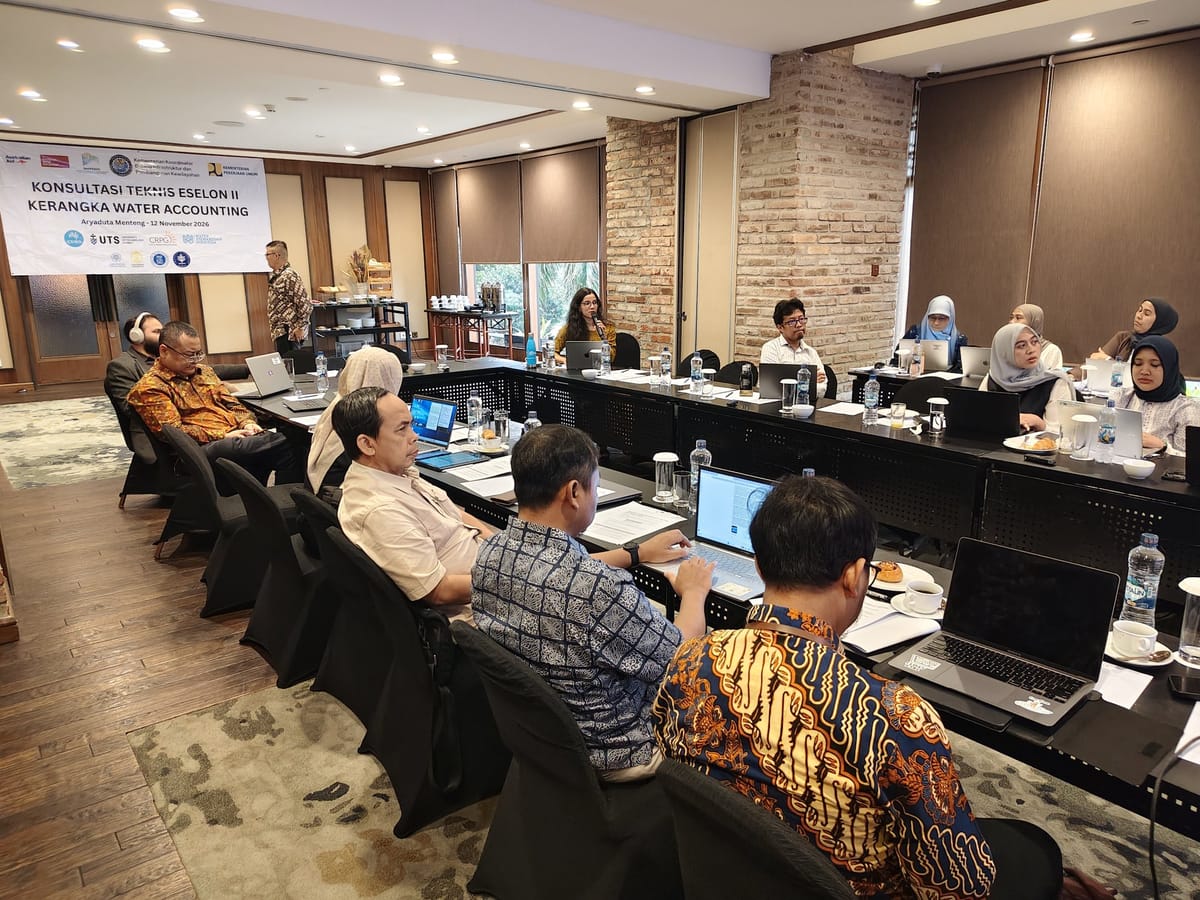
Photo: the Echelon 2 technical consultation on a water accounting framework, Hotel Aryaduta Menteng, Jakarta. Photo: project meeting record.
Indonesia draws up a water balance for every river basin each year. What it does not keep is a record of what was then actually used, by whom, and whether that use stayed within what the basin can bear. On 12 November, directors and senior officials from more than a dozen ministries and agencies met in Jakarta to weigh a framework meant to close that gap, and to say what it would take from each of them.
The meeting was the second of three steps in a consultation on a framework for Water Assessments, Allocation and Register of Accounts (AAA). A technical (Echelon 3) round was held on 20 October; this director-level (Echelon 2) round sought direction on scope, data and roles; and an Echelon 1 policy meeting is to follow. It was convened by the Coordinating Ministry for Infrastructure and Regional Development (Kemenko Infra) with the project that is piloting the framework in the Progo catchment of the Serayu–Opak basin, supported by the Australian Water Partnership from April 2026 to July 2027 and led by CSIRO, with Water Stewardship Indonesia (WSI), the University of Technology Sydney (UTS), Universitas Gadjah Mada, IPB University and CRPG. Bappenas and the ministries of Public Works, Energy and Mineral Resources, Environment, Forestry and Agriculture, together with BMKG and the secretariat of the National Water Resources Council, took part in person or online.
Kemenko Infra: measured, fairly allocated, recorded
Opening the consultation, Suraji, Kemenko Infra's Assistant Deputy for Water Resources and Food Infrastructure, summed up what the pilot is for: water that is "measured, fairly allocated and transparently recorded" (air terukur, teralokasi adil, dan tercatat transparan; CRPG's translation).
He began with drinking water, the use the framework draft had said least about. His slides put piped drinking water at 30.12 per cent of the population against an RPJMN target of 40.20 per cent for 2029, with 43.6 per cent of households buying refill or bottled water in 2024. Water utilities lose 33.51 per cent of their water on average, and 27,722 litres per second of treatment capacity sits idle, partly for want of raw water. The law already places that supply in the queue: Undang-Undang Nomor 17 Tahun 2019 tentang Sumber Daya Air (Law 17 of 2019 on Water Resources, BPK) ranks basic daily needs first, people's farming second and supply through piped drinking water systems third (Pasal 8 ayat (2)). Where piped service falls short, he said, households turn to groundwater, and that use goes unrecorded.
For the pilot area, Kemenko Infra's slides put piped coverage at about 20 per cent, licensed groundwater abstraction below 20 per cent of actual use, and 565 licensed wells against 5 monitoring wells, and concluded that the dry-season surface water deficit is probably being met from groundwater. The draft framework would insert water accounting into instruments that already exist: long-term assessment in the river basin strategy and plan, yearly allocation through the annual and real-time allocation plans, and an account at the end of each water year. Kemenko Infra proposed that basin plans be set by decision of the Coordinating Minister so that they bind every sector, and relayed the directions of a ministerial coordination meeting on water self-sufficiency, among them that ministries set aside sectoral interests in managing water data and that the Serayu–Opak basin serve as the pilot for integrated water accounting.
It asked the meeting for direction on six points: the pilot boundary; a focal point for each data custodian and a draft data-sharing protocol; a matrix of roles and a cross-ministry decision forum; the basis for allocating groundwater, including unlicensed use; the status of a sustainable allocation limit during the pilot; and the institutional future of the work.
WSI: not a new system
Fany Wedahuditama, Chairman of WSI, which facilitates the project's national engagement, moderated the day and set the frame. The framework is meant to complement Indonesia's existing instruments, not build a new system, and it must be agreed by every ministry involved before it can be applied. That is why the consultation is staged. From the Echelon 3 round he relayed that the Ministry of Public Works' water engineering centre had found the draft took account of existing instruments, with the links between them and groundwater as the weak points, and that participants had found authority over water data fragmented, with some 28 data items needed for a basin account held by many custodians.
The project follows the Water Scarcity Program, under which FAO worked with Bappenas and river basin agencies on Indonesia's water accounting roadmap and found that turning an account into an operational allocation was the step still unsolved.
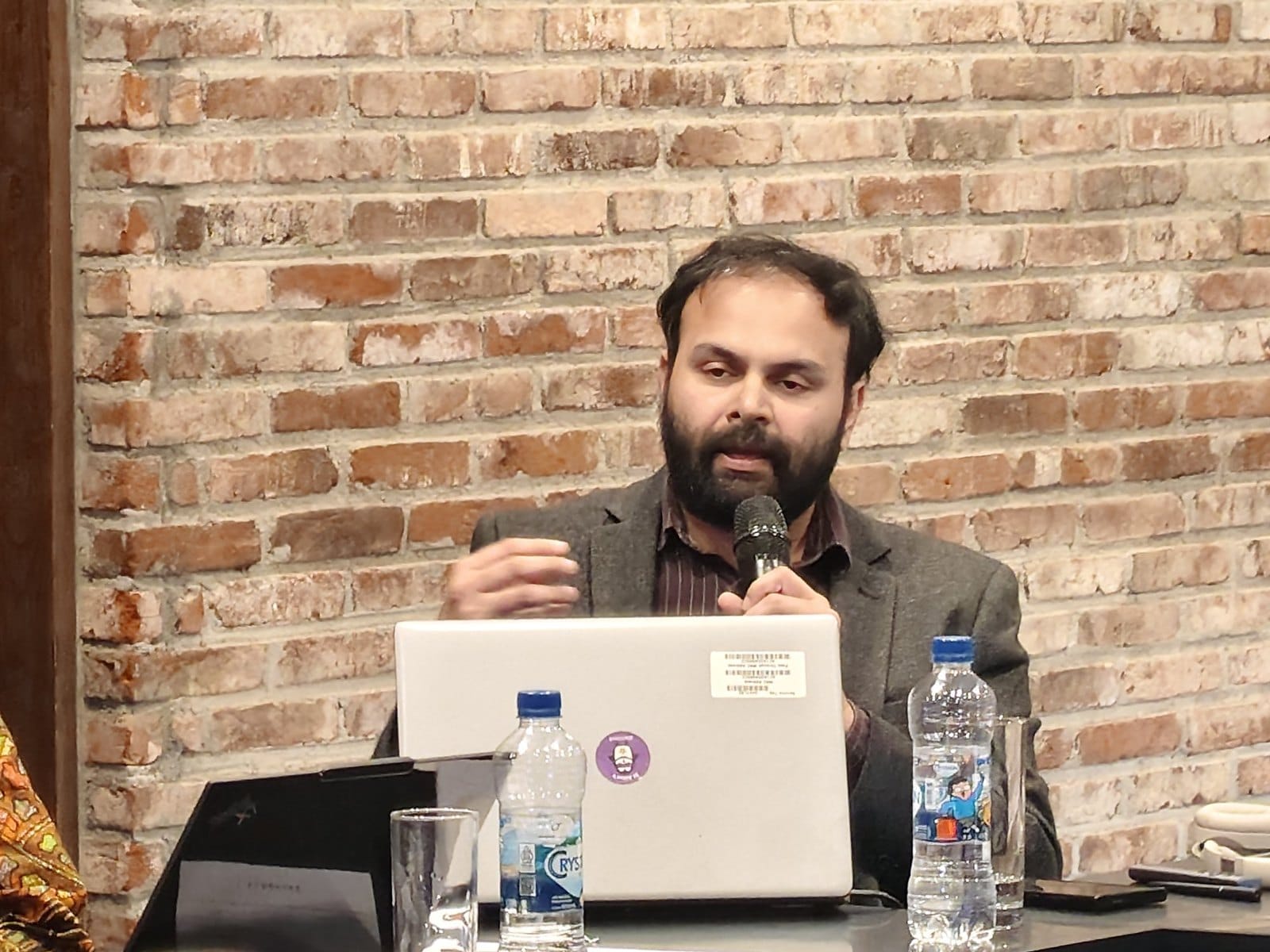
Photo: Sreekanth Janardhanan (CSIRO) presenting the AAA framework. Photo: project meeting record.
CSIRO: three components, one water year
Sreekanth Janardhanan, Principal Research Scientist at CSIRO Environment, presented the framework. Its three components share common water resource units and a defined water year. Water assessments look 5 to 20 years ahead, sit in the basin strategy and plan, and would set a sustainable allocation limit for each unit. Water allocation runs from the annual plan down to the 15-day real-time plan and decides who receives how much this year, within the limit, with surface water and groundwater handled together. The register of accounts is drawn up after each water year and records what was used and whether it stayed within limits.
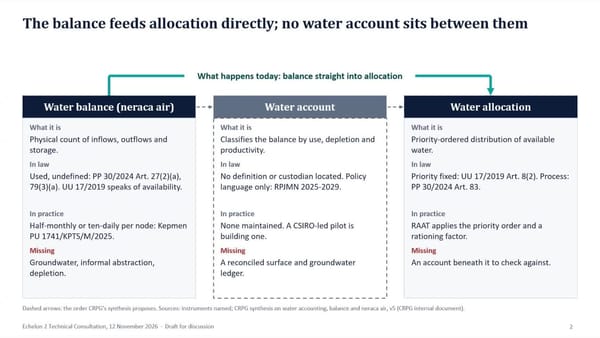
His assessment of current practice was balanced. The annual allocation plan is prepared for every river basin territory, the route from preparation to ministerial decision is clear, and the priority order is fixed in law. The gaps are that allocation sets an order of priority rather than a volumetric limit, relies on fixed dependable-flow criteria rather than the year's conditions, largely leaves groundwater out, and has no standard check of actual use against allocation.
He drew on Australia's Murray–Darling Basin, where CSIRO assessed sustainable yields for 18 regions and the Basin Plan set sustainable diversion limits for 109 units, 29 for surface water and 80 for groundwater. States allocate water, the basin authority keeps registers of take, an Inspector-General oversees compliance and the Bureau of Meteorology publishes a national water account. The lesson he drew is that science, allocation and compliance can sit with different bodies if they share units, a water year and reporting rules. He was careful about the comparison: Serayu–Opak's rivers drain to the sea separately, and whether the Progo faces comparable pressure is one of the questions the pilot must answer. So far the team has trained 16 staff of the river basin office in water accounting and social inclusion and convened a project advisory group through Bappenas.
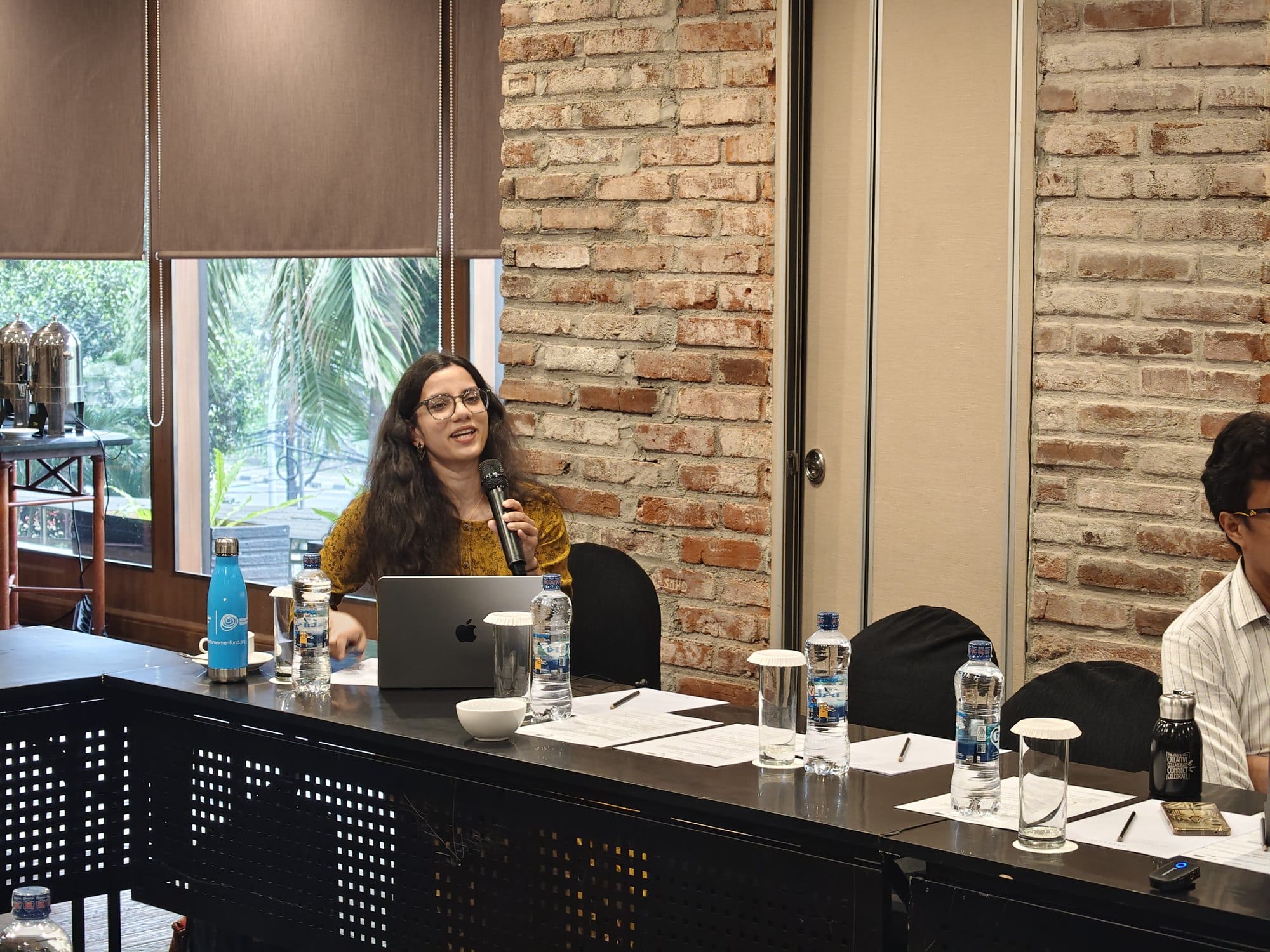
Photo: Avni Kumar (UTS) presenting on GEDSI in water accounting. Photo: project meeting record.
UTS: available to whom?
Avni Kumar, a researcher at UTS, argued that gender equality, disability and social inclusion (GEDSI) belongs inside water accounting, not beside it. The lens, she said, moves the question from how much water is available to "available for whom", for what purposes and under whose control. Models that ignore social norms and practices reproduce inequality in their outputs. Physical availability is not equitable access: a farmer close to an irrigation gate has a very different experience from one downstream, and women's water use in agriculture is easily undervalued. The project builds GEDSI into each work package, from training and fieldwork to model parameters. Existing socio-economic indicators, such as villages facing water scarcity or the share of female-headed households, are a starting point only: "looking at an area with female headed households does not tell us about who is making the water decisions."
What the ministries raised
The longest part of the meeting was the ministries' response. Several themes recurred.
Water quality. The Ministry of Environment said that water quality and pollution load are not yet clear in the framework, pointing to its own water quality data and its work on the pollution load capacity of rivers, and to non-point-source pollution as the large, unmanaged gap. Janardhanan agreed that quality "was not up front" in the framework as presented. The pilot's modelling cannot cover it, but "in terms of revising the framework document, we will bring water quality as a key priority."
Drinking water and groundwater competition. The Ministry of Public Works' drinking water directorate asked that the framework be aligned with the national drinking water master plan for 2025–2045, which projects raw water deficits for piped supply in its later years. Where piped networks exist, it said, groundwater abstraction by housing developers, hotels and industry needs to be restricted.
Groundwater that is hard to see. The Geological Agency called groundwater "invisible" and said much of its use is unlicensed. Monitoring wells, read against aquifer geometry, show where abstraction is excessive. Access to its data still runs through cooperation agreements or request letters, and it undertook to raise data sharing for water accounting with its management. The National Water Resources Council secretariat noted that the surface water balances used for basin plans may not yet include groundwater, and asked whether household use would be counted. Janardhanan answered that small unlicensed use can be estimated, with some approximation, from crop water demand and remote sensing, as is done in Australia.
Springs and recharge. The Ministry of Forestry's watershed directorate said its watershed offices are mapping spring recharge areas this year and that a national spring inventory with coordinates already exists, which Janardhanan called a valuable source for a national rollout.
Climate information and data exchange. BMKG said climate information should feed allocation, not only assessment, through forecasts from ten-day to seasonal, and that the hydrological information system should become a foundation of the framework rather than run beside it. Charges and cooperation agreements make data exchange a strategic issue for the Echelon 1 meeting; meanwhile BMKG co-produces tailored information with partners.
Who owns the guideline. The Directorate General of Water Resources said a guideline on the water balance is being drafted for issue next year. The moderator asked who would own it once groundwater and springs are added, and whether it would need to be joint across ministries.
Bappenas, for its part, stressed that assessment, allocation and accounting serve distinct functions, flagged incomplete data, monitoring and compliance, and asked whether the national and basin modelling platforms complement each other or one must be chosen.
Next steps
Closing the meeting, Bappenas said it had produced several alternative solutions for data exchange, while the question of who acts as data custodian remains open. Bappenas will coordinate with Kemenko Infra, and the next step is a written stakeholder commitment, a "joint forces" document from ministries, development partners and local governments setting out roles and responsibilities, so that the framework can be applied. Ministries were asked to return structured written input. For the project, Janardhanan listed what it takes away: water quality, the link to the drinking water master plan, and the water security index, with a follow-up meeting before the pilot is implemented.
For CRPG
CRPG leads the project's governance and institutional review. Its findings, presented to the same meeting by CRPG Director Mova Al'Afghani, are reported in a separate article. CRPG first reported on the project at its inception workshop in May.
Disclaimer
This article was AI-generated under an experimental legal-AI application. It may contain errors, inaccuracies, or hallucinations. The content is provided for informational purposes only and should not be relied upon as legal advice or authoritative interpretation of regulations.
We accept no liability whatsoever for any decisions made based on this article. Readers are strongly advised to:
- Consult the official regulation text from government sources
- Seek professional legal counsel for specific matters
- Verify all information independently
This experimental AI application is designed to improve access to regulatory information, but accuracy cannot be guaranteed.