'We pay three times over': FAO and the development banks on the cost of drought unpreparedness
At the Rome Water Dialogue's drought session, FAO, the GEF, IFAD, ADB and the Islamic Development Bank agreed that the money for resilience exists; the bottleneck is prepared, governed, bankable projects.

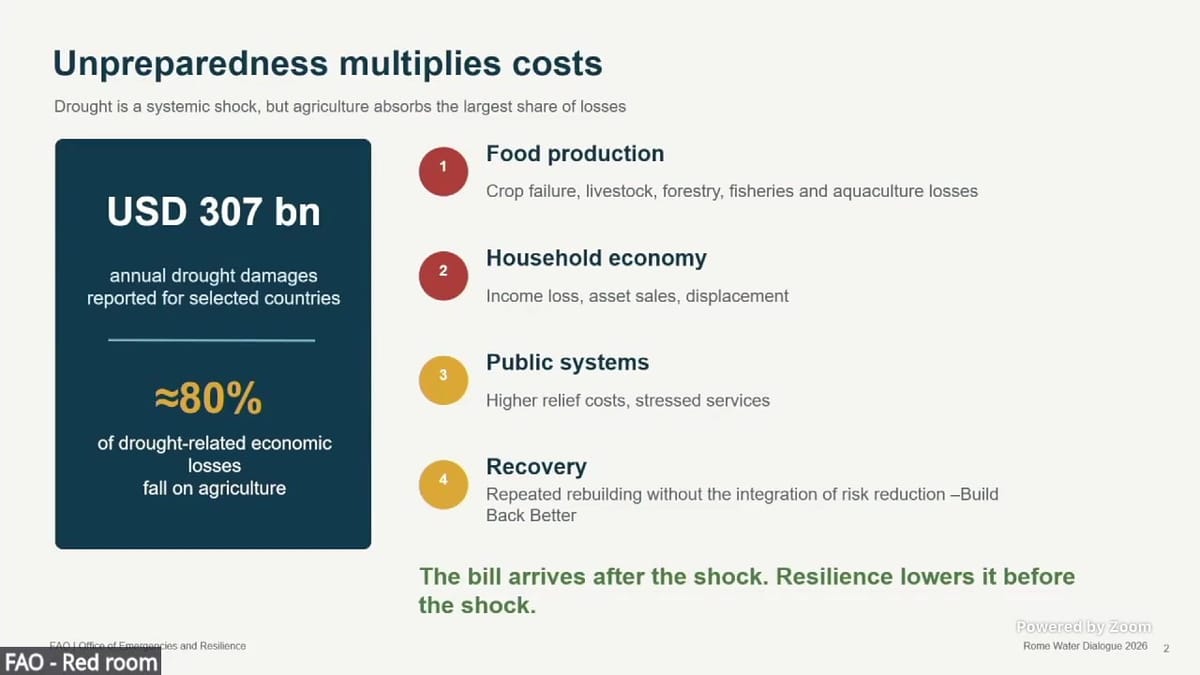
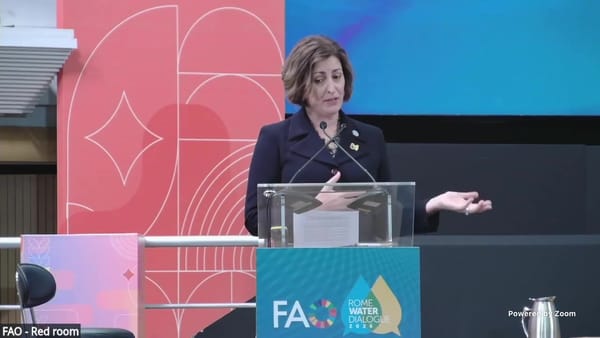
Rome, 13 October 2026. "As countries, as societies, ultimately we pay three times over." Rein Paulsen, Director of FAO's Office of Emergencies and Resilience, explained the arithmetic to the technical session on drought management and irrigation at the FAO Rome Water Dialogue 2026: "The first time we pay is in terms of assets and production that is lost. The second time that we pay is when we have to mount expensive post-facto, post-event humanitarian and emergency responses. And the third time we pay, of course, is when the necessary rebuilding of systems takes place."
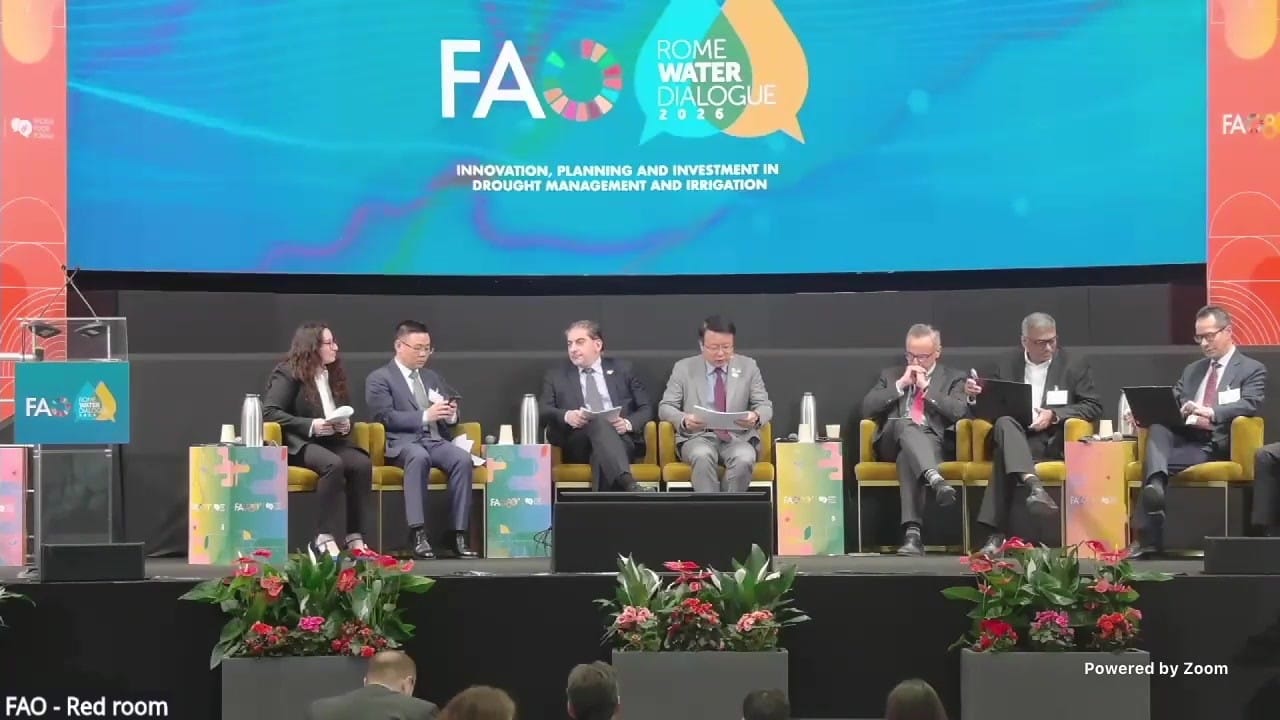
The rest of the morning's second half was about how to stop paying three times. Three presentations from FAO and the Global Environment Facility were followed by a panel of development banks, FAO's Investment Centre and country representatives, chaired by Lifeng Li, Director of FAO's Land and Water Division. They kept returning to the same bottleneck. The money for drought resilience exists. What is missing is prepared, governed, bankable projects to spend it on.
A pump is not resilience
Paulsen's central message was that "a drought becomes a food crisis not only when there is a challenge with rainfall, it becomes a food crisis because systems are not sufficiently prepared." Preparedness is therefore "not an additional cost", but the main way to avoid compounding costs.
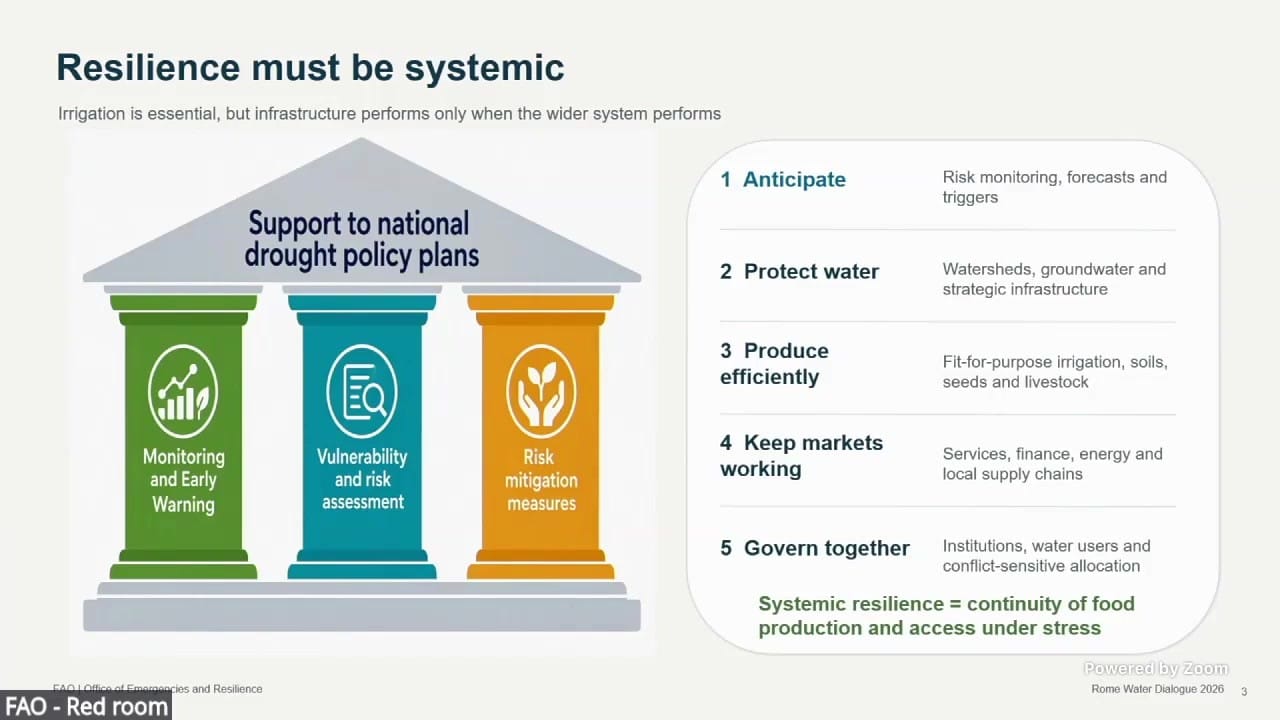
He also warned against equating resilience with hardware. "Hardware, the existence of a pump or an irrigation canal alone, of course, is not resilience." Infrastructure fails when energy is unaffordable, groundwater is mismanaged, spare parts are missing, conflict blocks access, or farmers cannot reach finance and markets. His five functions for a resilient system ended with governance: "actions to govern scarce water resources fairly ... all the way down to the level of water users and individual farmers." In most countries where FAO works on drought, he said, "water is not only scarce, but often water can be a contested resource", so policy must be conflict-sensitive, "so that water points, canals, grazing routes become sources of cooperation rather than sources of tension."
He cited FAO's joint anticipatory action plan with the World Food Programme for the current El Niño, targeting nearly nine million people in 22 high-risk countries, and called for three shifts: from late response to anticipatory action tied to "pre-arranged financing"; from isolated assets to working systems, in which irrigation comes "with institutions, with sustainable water allocation, energy, maintenance, service and market access"; and from drought plans to "costed country portfolios" that can blend domestic, concessional, climate and private finance.
From plan to portfolio
Edoardo Borgomeo, Senior Freshwater Specialist at the Global Environment Facility (GEF), said drought is changing: it compounds with floods and heatwaves, strikes several breadbaskets at once, and follows other shocks. The GEF, the financial mechanism of the UN Convention to Combat Desertification, has funded drought work mostly project by project. In its new four-year cycle, GEF-9, replenished at about 4 billion US dollars, it is setting up an integrated programme on drought and drylands of around 140 million dollars. "Admittedly, that's not a lot of money," he said; the GEF uses small grants to catalyse larger investment.
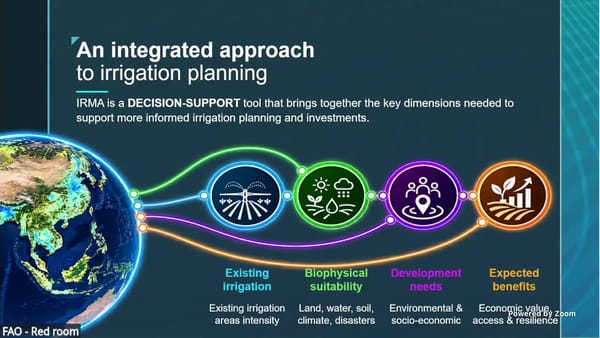
Stefania Giusti, Programme Officer in FAO's Land and Water Division, described FAO's stepwise method for turning national drought plans into investment portfolios. It starts by assessing where impacts and vulnerability meet economic potential, then takes stock of mitigation options with national institutions (119 options in Eswatini), aligns them with national priorities, and builds investment cases with financial indicators that show returns. "Drought risk management is not a sector," she concluded. "It is an umbrella intervention."
What the banks said
IFAD. Juan Carlos Mendoza, Director of the Environment, Climate, Gender and Social Inclusion Division at the International Fund for Agricultural Development, said IFAD has about 3 billion US dollars invested in water resilience. To ministers of finance, he cited estimates that drought can cut the GDP of lower-income countries by around 15 per cent. He called for measuring "avoided losses", linking early warning to "pre-agreed actions with thresholds and source of finance", and a "cultural change to ensure that drought resilience is seen as an investment with a measurable return, not simply as emergency spending". All new IFAD projects, he said, are designed with contingency lines for drought response.
Asian Development Bank. Narayan Iyer, Principal Natural Resources and Agriculture Specialist, said ADB is moving "from responding to emergencies and losses to managing drought risk". That means landscape and river basin planning instead of single projects, natural capital alongside hard infrastructure, combined sources of finance, and institutions "to have a better and more responsible way of ... allocating water resources". He mentioned regional work in Central Asia, and a new ADB initiative, launched two months earlier, to restore degraded land and watersheds, with a goal of mobilising at least 2 billion US dollars by 2035.
Islamic Development Bank. Nizar Zaied, Manager for Agriculture, Water Resources and Rural Development, said almost 1 billion US dollars of IsDB drought finance in recent years went about 97 per cent to long-term investment, including a 330-million-dollar Sahel resilience programme with CILSS in five countries. He listed what must be in place: evidence; ownership, with maintenance "built in at the start"; and well-prepared projects. On ownership he was specific: "for irrigation particularly ... it means recognizing water user associations ... and securing farmers' lands", citing the Kazakh vice minister's account of water user associations in Kazakhstan's water code. His single change: "fund preparation first". IsDB spends only 1 to 2 per cent of approvals on preparation, "but that's what decides whether the remaining 98% deliver on time or not."
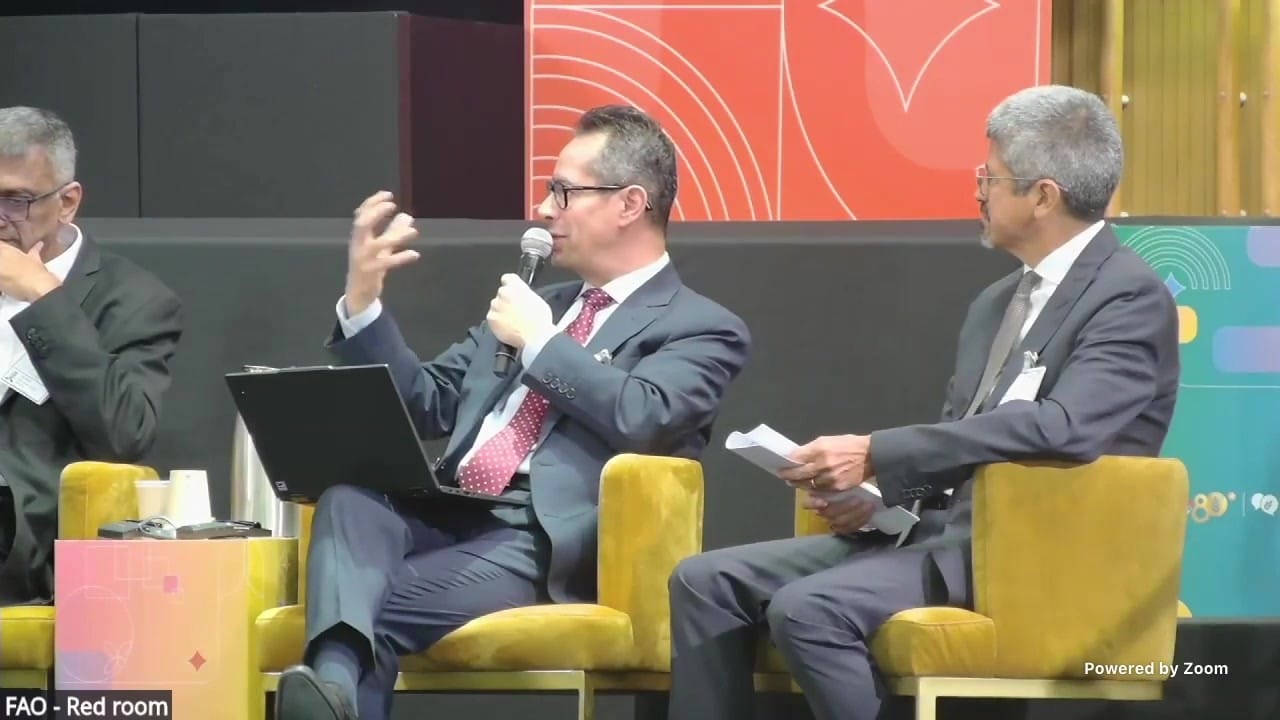
FAO Investment Centre. Giovanni Munoz, Chief of the East and Southern Africa Service, said every drought plan "should by default from the beginning already include a component on investment", naming the actions, locations and methods. Solutions are not always in water: Zimbabwe's drought strategy has six pillars, only two of them about water, including strategic grain reserves and easier food imports. And water investments should be embedded in a river basin management plan "discussed and agreed upon" by "all the different sectors and uses of water within a basin".
The country view
Shalala Hasanova, Head of the Strategic Development Department at Azerbaijan's Water and Amelioration Scientific Research Institute, said about 77 per cent of Azerbaijan's renewable water comes from beyond its borders, and agriculture accounts for more than 90 per cent of withdrawals. Its national strategy on efficient water use to 2040 aims to cut irrigation losses sharply. Subsidies now reward efficiency: wheat under modern irrigation receives twice the sowing subsidy of conventionally irrigated wheat, and drip systems are discounted by up to 60 per cent, "so this makes saving water a business decision from farmers, not only a policy goal." But agricultural water is not yet measured at field level, and the target is full metering of main reservoirs and canals by 2027: "Without measurement, of course, we cannot manage and investors cannot see the result."
Wang Yingchun of China's Changjiang (Yangtze) Water Resources Commission spoke in Chinese. In the parts of his remarks that are audible in the recording, he described using AI models to extend medium- and long-term drought forecasting, and pre-storing water in reservoirs when drought is forecast, within flood-safety limits, so that flood water becomes a resource.
The tenure question inside bankability
Zaied's point about water user associations and farmers' land is the one most easily lost in a discussion about finance. An irrigation project is bankable only if someone can be held responsible for operating and maintaining it, and the water it delivers can be allocated predictably. That requires recognised user organisations and secure rights to land and water. In Indonesia, water user associations (P3A) are recognised in law, but a good deal of the water that farmers actually use moves through informal arrangements outside the formal system. CRPG Director Mova Al'Afghani, PhD, made the case at the Dialogue's water tenure session for making those users visible (read our report: Making invisible water users visible). Paulsen's call to govern water fairly "all the way down to the level of water users and individual farmers" is the same demand, seen from the emergency side.
The ministerial panel that opened the same session is covered in our report on the ministers.
A note on sources. The UN has not published a transcript of this session. Quotations and figures are taken from the session's English audio channel on UN Web TV, transcribed automatically by CRPG with Whisper, and lightly edited for false starts; omissions are marked with an ellipsis. Figures are as the speakers stated them. The remarks of the Syrian ambassador and parts of Wang Yingchun's remarks were not intelligible in the recording and are not reported. If a UN transcript is published, the quotations will be checked against it and any change will be noted at the foot of this article. Images: ©FAO, stills from FAO's webcast of the session on UN Web TV.