'Rights before restoration': the Rome Water Dialogue's restoration panel puts tenure at the centre
A review of 61 restoration cases found that secure, flexible tenure and co-design make restoration investment last. Panellists from science, farming, conservation and standards said soils, wetlands and rangelands lack governance, not know-how.

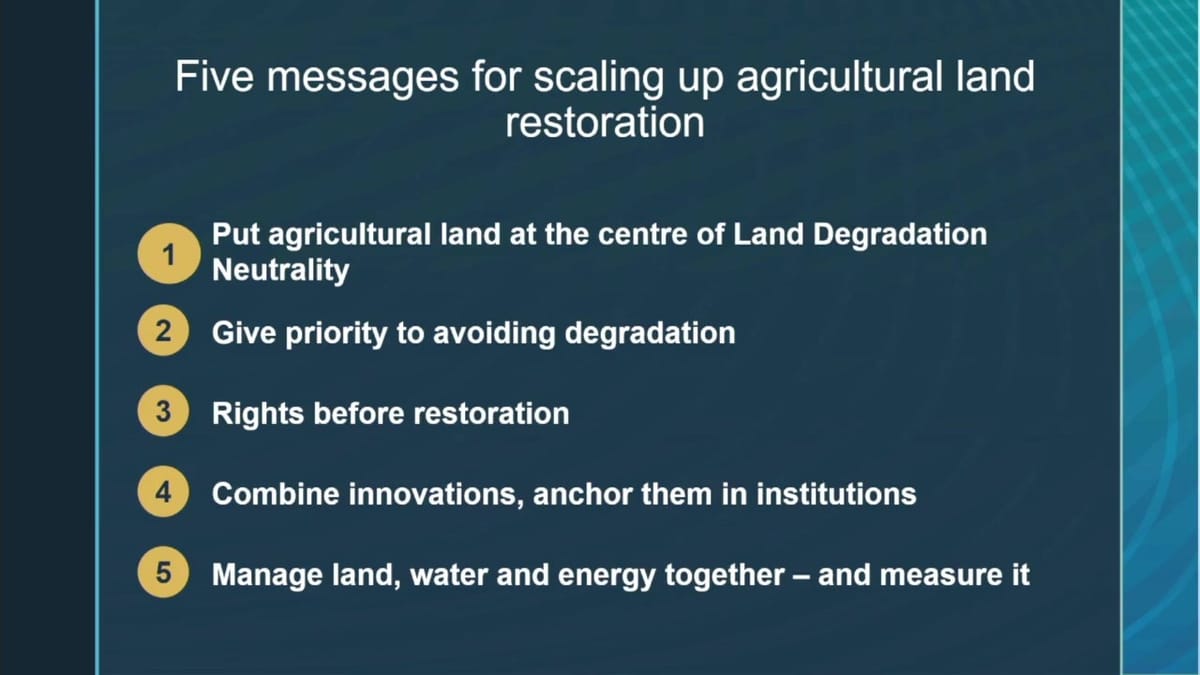
Rome, 12 October 2026. "Rights before restoration." That was the third of five messages that Linxiu Zhang, Director of the UNEP International Ecosystem Management Partnership (UNEP-IEMP), put on the screen at the restoration session of the FAO Rome Water Dialogue 2026. As she put it: "securing flexible tenure and co-design make investment last."
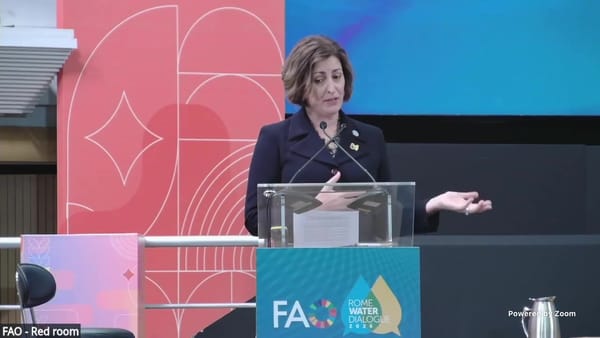
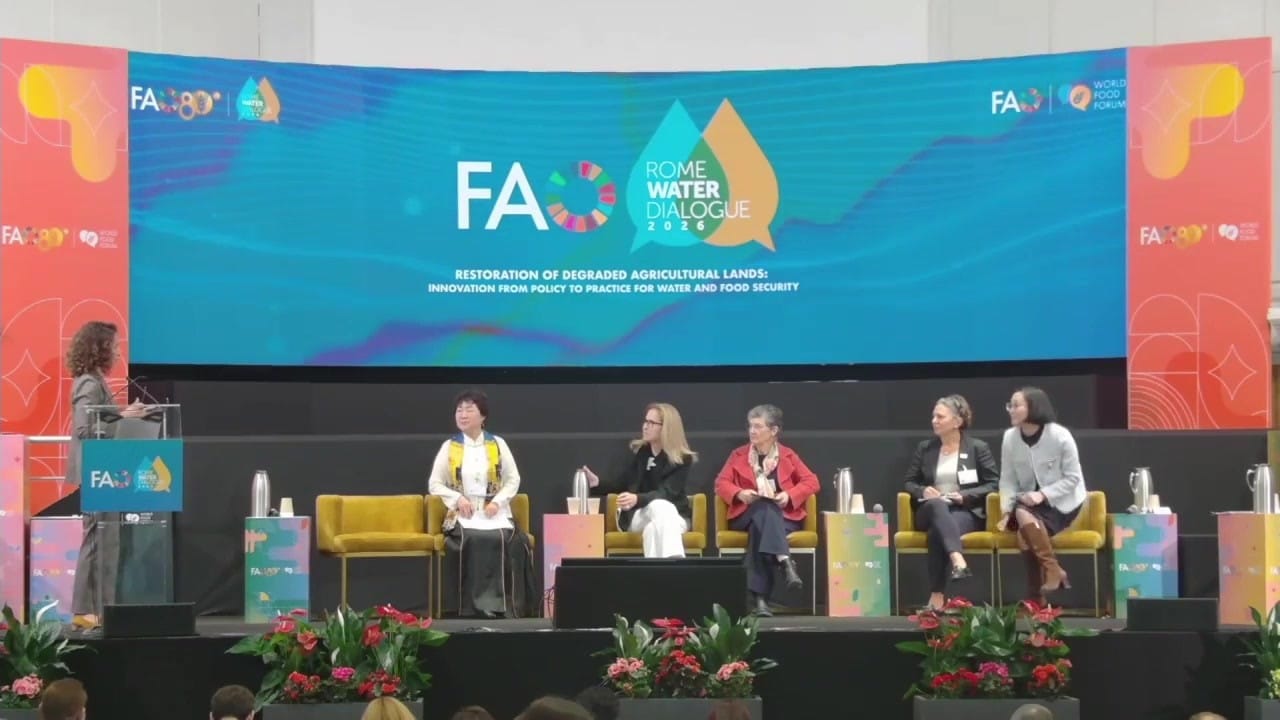
Zhang opened the technical panel of the session Restoration of degraded agricultural lands: innovation from policy to practice for water and food security, held in FAO's Red Room on Monday. The high-level segment that preceded it, with Kenya, Jordan, Kazakhstan, the Russian Federation and Central America, is covered in our earlier report. This article covers the panel: five women from science, production, conservation and standard-setting, moderated by Jamal Annagylyjova, Senior Land and Water Officer at FAO.
What 61 cases show
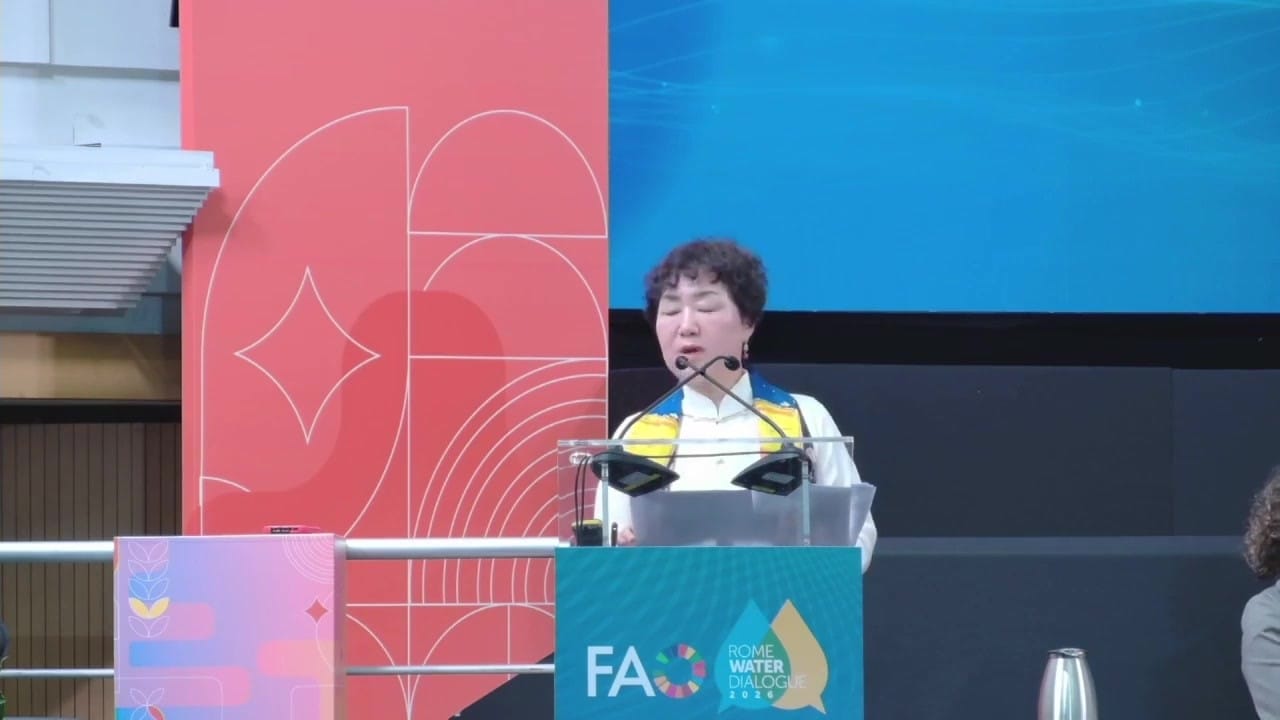
Zhang presented the first volume of a global compendium of practice on sustainable management and restoration of agricultural lands and soils, prepared by FAO and UNEP-IEMP, on rangelands, pastures and grasslands. Of about 1.66 billion hectares of degraded land worldwide, she said, "more than 60% of this is agricultural land that feed us all", yet restoration "had long been focused on areas of high biodiversity value". A joint call for field-tested practices drew 61 cases from more than 30 countries; 31 were assessed in depth, 15 selected, and seven singled out as innovative.
The lessons were specific. "No single type of innovation works alone": every case combined at least two, and institutional innovation contributed in six of the seven. Only three cases concentrated on avoiding degradation rather than reversing it, and all three were driven by financial innovation. In Inner Mongolia, herders and global brands agreed longer-term sourcing contracts that reward grazing within carrying capacity across 152,000 hectares; on China's Loess Plateau, restoration built into national planning raised vegetation cover from about 32 to 75 per cent. Technology also needs safeguards: in Dalad Banner, in China, wind and solar projects were combined with crop-livestock production and benefit-sharing for ecological restoration, showing that "the outcome depends on the design".
She also named the gaps: finance that lasts beyond pilots, a very small share of finance for small-scale producers, women and youth, no cases in conflict settings "yet where restoration needs are often the greatest", and field monitoring that does not yet feed national land degradation neutrality reporting. Her five messages were to put agricultural land at the centre of land degradation neutrality; give priority to avoiding degradation, "the most cost-effective option, yet incentives for it remain limited"; rights before restoration; combine innovations and anchor them in institutions; and manage land, water and energy together, and measure the results. FAO and UNEP-IEMP used the session to launch the call for practices for volume two, on croplands.
"Soils lack governance"
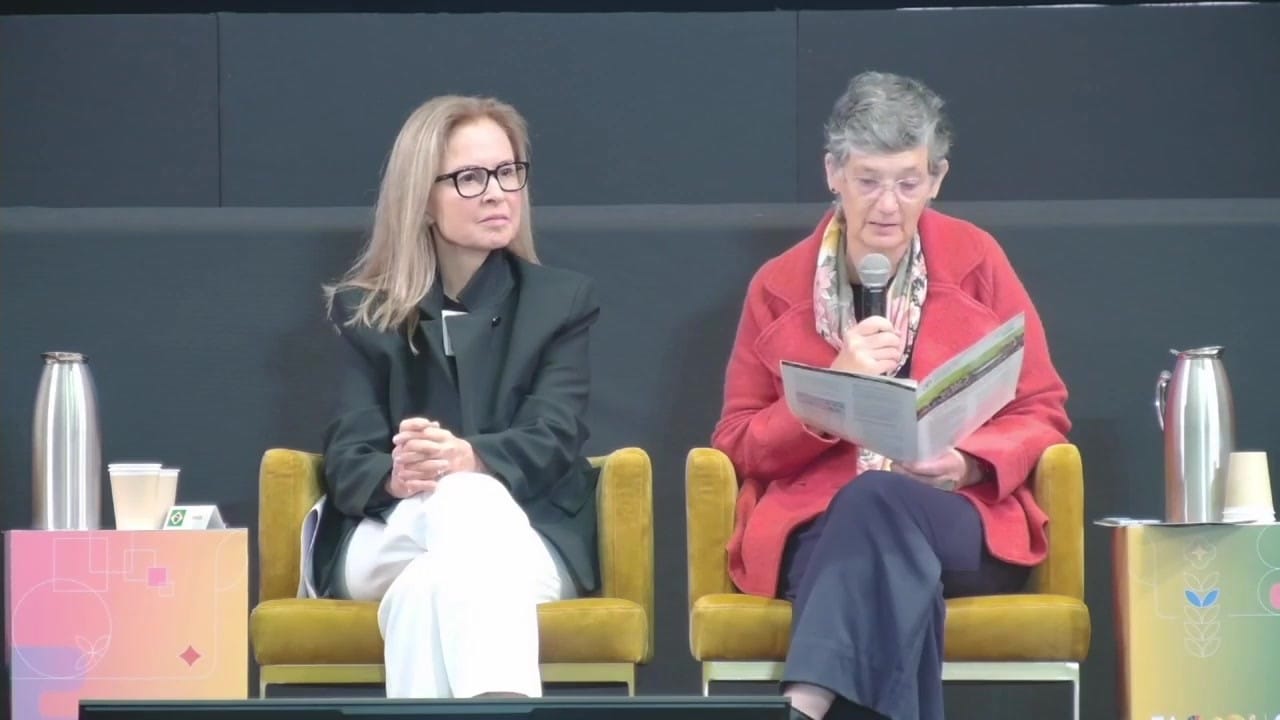
Rosa Poch, Professor of Soil Science and Agricultural Chemistry at the University of Lleida, said the science has advanced, citing the second Status of the World's Soil Resources report released in August, but its main conclusions "are not scientific ... these conclusions are rather economical, political, and social. So we know what to do in most cases, but the political tools and the socioeconomical structures required to make it happen are missing or are incomplete." The European Union's Soil Monitoring Directive, she said, is a historic step that puts soils "in the same level of air and water", but its transposition by member states is slow. Her summary: "soils lack governance."
"Let the water flow"
Teresa Vendramini, a livestock farmer and member of the Council for Sustainable Economic and Social Development of Brazil, said Brazil has about 177 million hectares of pasture, 60 per cent of it showing some degradation, and a target of restoring 30 million hectares of degraded pasture by 2030, backed by the low-interest credit programme RenovAgro.
Francesca Antonelli, Head of Rivers and Lakes at Wetlands International, took the panel to the Paraná Delta in Argentina, where cattle farming is traditional but dikes, embankments and canals built to reclaim land from water had degraded the soil. The Corredor Azul programme's protocol starts from one rule: "re-wet. Don't build dikes, embankments, canals. Let the water flow." It works through a voluntary agreement between farmers and a technical team, a baseline assessment done with the farmers, and monitoring of indicators from water quality to calf mortality. The result, she said, is a more resilient landscape and more productive livestock. "If you work for the wetlands, the wetlands will work for you."
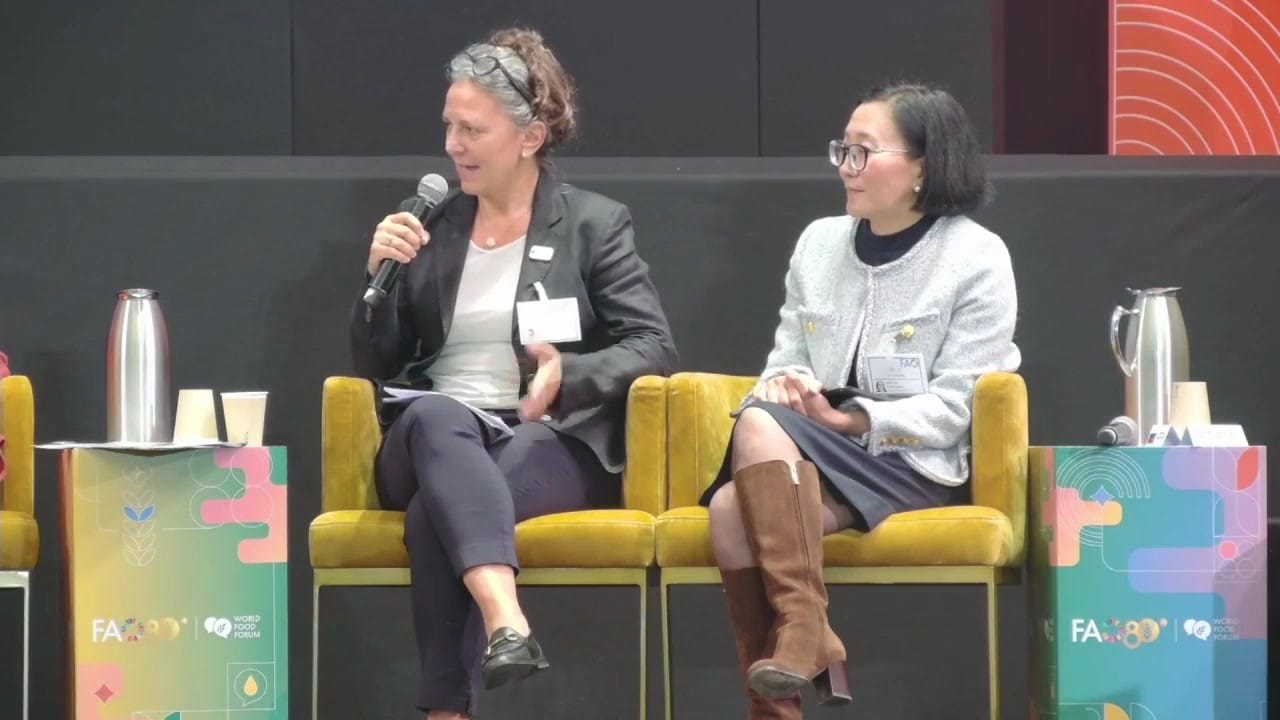
Una Jones, Chief Executive Officer of the Sustainable Fibre Alliance, spoke from ten years with herder communities in Mongolia, which produces about half of the world's cashmere and where herders depend on it for most of their income. If a standard "doesn't work for herders and communities, it will not work at all," she said; it must combine traditional ecological knowledge with science. The Alliance's standard, she said, now reaches about 160,000 herders in China and Mongolia, and has been used to bring market finance and green loans to rangeland restoration; a global rangeland standard was launched at the UNCCD COP17 in Ulaanbaatar.
One system
Closing the session, Lifeng Li, Director of FAO's Land and Water Division, said the morning began with one idea, "land, soil, and water are one system", and one question: not whether to restore degraded agricultural land, but how to scale it up. Data matters "when people use it to make decisions", he said, and must reach farmers' hands: "the soil passport, but probably also the water credit card". Reversing degradation on 10 per cent of degraded agricultural land, he said, could feed about 154 million people.
Rights before restoration, in Indonesia
Zhang's third message is the one CRPG would underline. Restoration asks farmers and herders to invest now for benefits later; they will do so only if they are confident the land and the water will still be theirs. Antonelli's re-wetting protocol works because farmers agreed to it; Jones's standard works because herders shaped it. In Indonesia, where many farmers and communities hold land and water under customary or informal arrangements that the formal system does not record, restoration programmes that skip the tenure question risk failing for the reasons the panel described. CRPG Director Mova Al'Afghani, PhD, made the case for recording those users at the Dialogue's water tenure session the same morning (read our report: Making invisible water users visible). For the land and water tenure link from the UNCCD's side, see our report on Yasmine Fouad's message.
A note on sources. The UN has not published a transcript of this session. Quotations and figures are taken from the session's English audio channel on UN Web TV, transcribed automatically by CRPG with Whisper, and lightly edited for false starts; omissions are marked with an ellipsis. Where the recording was unclear, wording was checked against the slides shown in the webcast. Figures are as the speakers stated them. If a UN transcript is published, the quotations will be checked against it and any change will be noted at the foot of this article. Images: ©FAO, stills from FAO's webcast of the session on UN Web TV.