'Fund us to carry out the solutions': young people present a water governance declaration at the Rome Water Dialogue
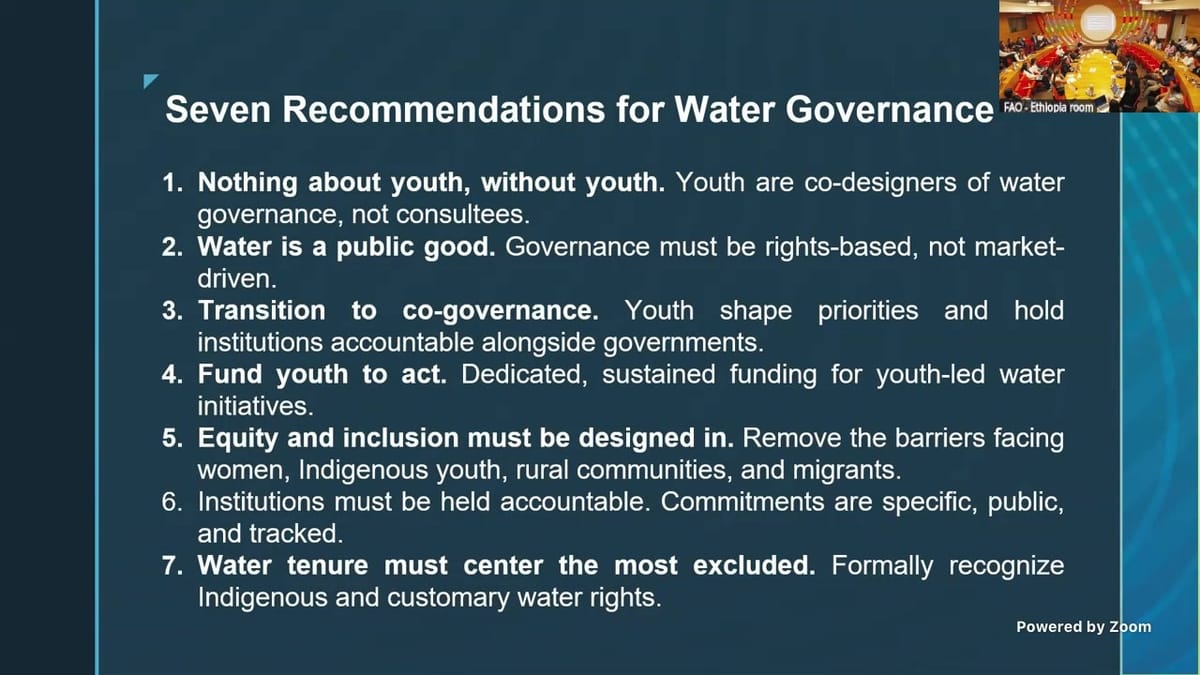
At the Youth Assembly, the World Food Forum Youth Policy Board presented a draft youth declaration with seven pillars, from co-governance and dedicated funding to formal recognition of Indigenous and customary water rights.

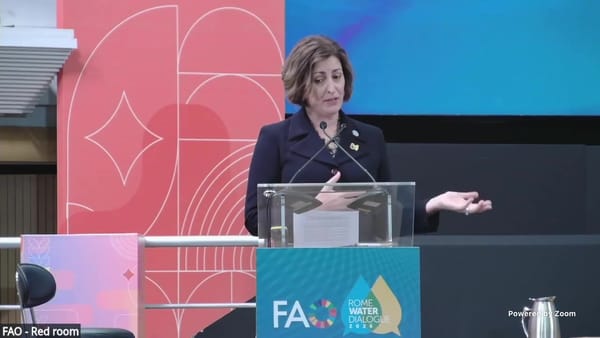
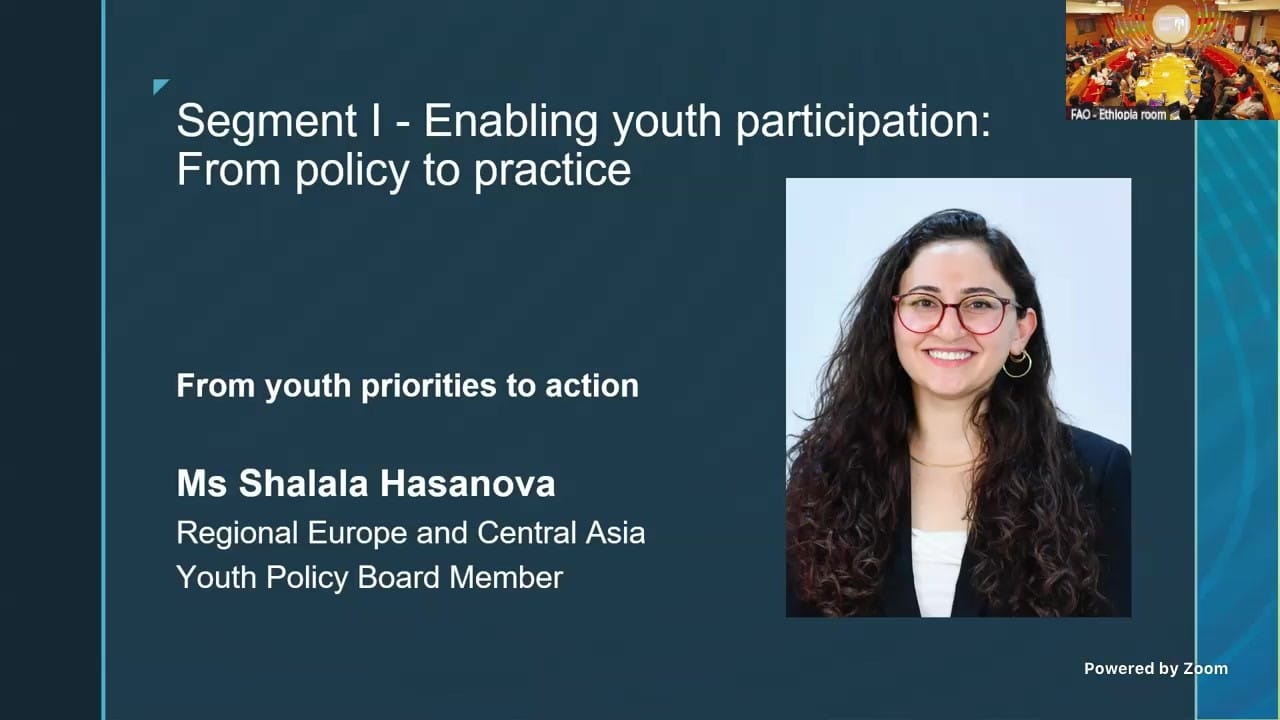
Rome, 15 October 2026. "Stop inviting us to testify about the crisis. Fund us to carry out the solutions." Shalala Hasanova was quoting a young respondent from Senegal to the Youth Assembly session of the FAO Rome Water Dialogue 2026. "That person said it even better than I can express here," she said. Hasanova, the World Food Forum Youth Policy Board member for Europe and Central Asia, was presenting the draft Youth Declaration for Water Governance and Sustainable Water Management in Agriculture. The session was held on Thursday afternoon in FAO's Ethiopia Room.
It was moderated by the Youth Policy Board's water leads, Manal Bidar and Jeremy Repetto, and brought young professionals and innovators together with FAO staff and two member-state representatives.
What young people said
The declaration was built over several months. Hasanova described two global online consultations, one on SDG 6 and one on the responsible governance of water tenure, held with FAO's ScaleWat water tenure project, and a global survey in English, French, Arabic and Spanish. Young people from more than 70 countries took part: nearly half were young women, 43 per cent came from rural communities, and a quarter identified as Indigenous. The team also reviewed 26 existing frameworks and declarations "because we didn't want to write one more document that repeats the others". She was frank about the limits: most respondents came from the Global South, and an online process reaches only those with internet access.
The finding, she said, is that young people "are shut out of water governance", although "we are on the front line of water crisis and we are already building solutions." Only 3 per cent of respondents said young people are often included in water decisions, while three in four were involved in, or aware of, a youth-led water initiative, from drone-based irrigation mapping in Kenya and groundwater sensors in the Philippines to solar water towers in Chad and community water governance "built on ancestral knowledge in Senegal". "Young people aren't short of ideas. They are short of access, resources, and power."
Seven pillars
The draft sets out seven recommendations for water governance, as shown on the session's slide:
- Nothing about youth, without youth. Youth are co-designers of water governance, not consultees.
- Water is a public good. Governance must be rights-based, not market-driven.
- Transition to co-governance. Youth shape priorities and hold institutions accountable alongside governments.
- Fund youth to act. Dedicated, sustained funding for youth-led water initiatives.
- Equity and inclusion must be designed in. Remove the barriers facing women, Indigenous youth, rural communities and migrants.
- Institutions must be held accountable. Commitments are specific, public, and tracked.
- Water tenure must center the most excluded. Formally recognise Indigenous and customary water rights.
Behind the pillars are survey numbers: 59 per cent named formal participation mechanisms as the most important change needed, and 52 per cent dedicated funding for youth-led initiatives. "Asking youth to participate without giving them the means to do so is still tokenism," Hasanova said. On the seventh pillar she went further than the slide: Indigenous and customary water rights "must be formally recognized in law", and young people need routes to secure water access "that don't depend on inheritance, money or political connections."
She was candid about precedent. Youth declarations at the 2023 UN Water Conference and elsewhere "all made similar calls", and "none of them has been fully implemented." Quoting a Kenyan participant: "every new commitment should begin with an accounting of the previous one." The declaration is still a draft; the moderators said it would be revised with the session's input and carried to the UN Water Conference in Abu Dhabi in December.
From consultation to co-creation
Several speakers drew the same line between consulting young people and sharing decisions with them.
- Nora Berrahmouni, Deputy Director of FAO's Land and Water Division, opened by telling the room that young people are "not the leaders of tomorrow ... you are the leaders of today", and described the division's youth group and its "Wasala" networking initiative.
- Nosipho Nausca-Jean Jezile, Ambassador and Permanent Representative of South Africa to FAO, said South Africa treats water as "a common resource" that "is not owned by one person", governed under its National Water Act, and said South Africa co-chairs the UN Water Conference's interactive dialogue on investment in water, where she hoped young people would be included.
- Roman Diatka, Counsellor at the Czech Republic's Permanent Representation to FAO, proposed joint field research, student innovation labs and doctoral internships between FAO and universities: "cooperation is the winning strategy."
- Lucie Chocholata, Capacity Development Officer in FAO's Land and Water Division, described the Agrifood Leadership Education Programme on Water Action (ALEP-WA), launched by FAO's Director-General at last year's World Food Forum.
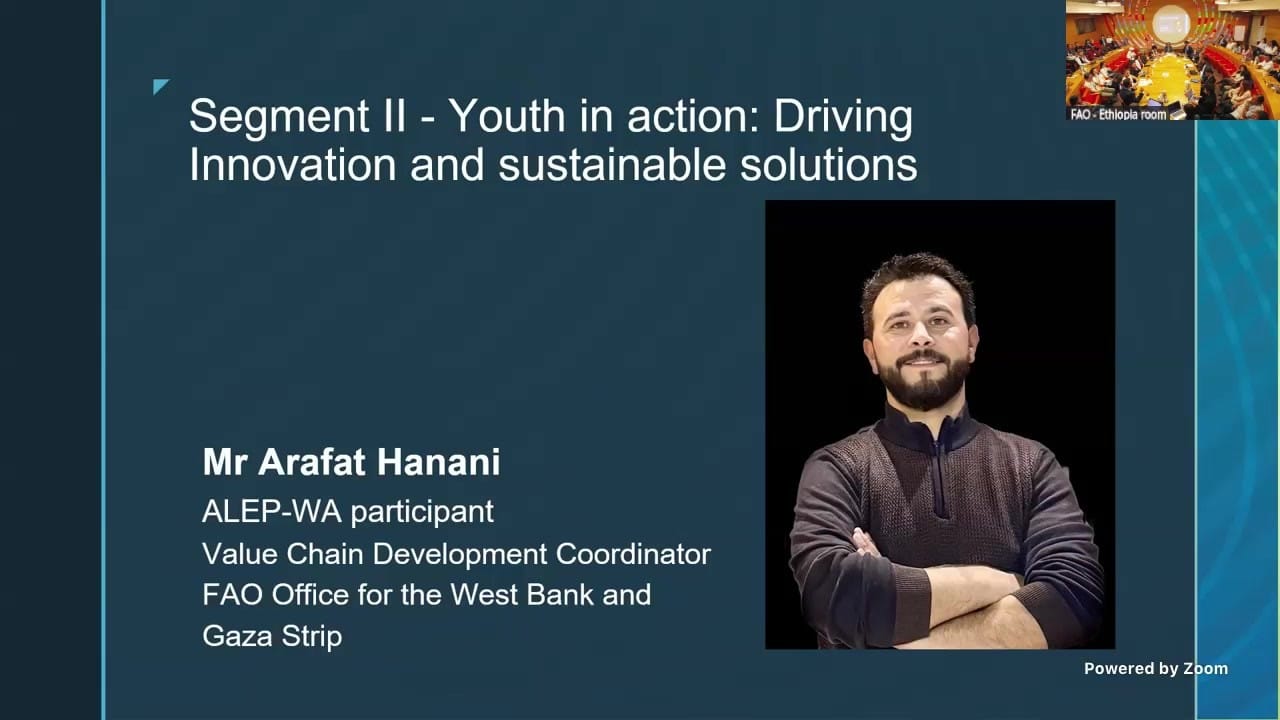
- Arafat Hanani, an ALEP-WA participant who coordinates value chain development at the FAO office for the West Bank and Gaza Strip, presented his "Blue Pulse" data platform idea and gave policymakers one recommendation: "when you involve youth, don't consult them. Bring them to the table." In fragile settings, he added, what young innovators need most is "de-risking".
- Rosaida Dolce, Water and Environment Specialist at FAO, put it as a shift "from consulting youth to co-creating with youth".
- Leunell Chris Buela of the University of the Philippines Los Baños described AquaSmart, low-cost sensors to monitor groundwater under solar-powered irrigation schemes that have no monitoring system, funded through the World Food Forum's research challenge. Jesse Papirio of Rise Nutrition described youth committees running community projects in rural El Salvador.
Near the end, a water lawyer from FAO's Development Law Service made a point the declaration's seventh pillar depends on: good water laws are binding rules, "adopted by parliament or by ministers", and the work now is "implementation of those laws ... compliance ... and enforcement". Avishek Duhonarrain, the Youth Policy Board member for Africa, closed by asking member states and FAO to circulate the declaration once it is published.
The seventh pillar, in Indonesia
The youth declaration ends where the week began. Its seventh pillar, formal recognition of Indigenous and customary water rights, is the first of FAO's draft principles for the responsible governance of water tenure, and the one CRPG Director Mova Al'Afghani, PhD, chose to highlight on Monday's water tenure panel, citing the wealth of customary water tenure among Indonesia's many ethnic groups (read our report: Making invisible water users visible). Hasanova's addition, that access should not depend on inheritance, money or connections, is a reminder that tenure security is also a question of who can enter farming at all. For the youth voice in the high-level session the day before, see our report on the stakeholder panel.
A note on sources. The UN has not published a transcript of this session. Quotations are taken from the session's audio on UN Web TV, transcribed automatically by CRPG with Whisper, and lightly edited for false starts; omissions are marked with an ellipsis. The text of the seven pillars is taken from the slide shown in the webcast; the declaration itself is a draft and may change. Names and titles follow FAO's event agenda; the name of the FAO Development Law Service speaker could not be confirmed and is not given. If a UN transcript is published, the quotations will be checked against it and any change will be noted at the foot of this article. Images: ©FAO, stills from FAO's webcast of the session on UN Web TV, which showed slides and speaker cards rather than the room.