Where irrigation pays: FAO launches IRMA, and lenders warn that irrigation raises the stakes for land and water rights
FAO's new IRMA platform maps where irrigation is feasible, needed and profitable. At its launch, IFAD warned that irrigation raises land values and disputes, and China described rights-based water allocation in the Yangtze basin.

Rome, 13 October 2026. "The moment you bring irrigation, the value of land increases and disputes may increase." Juan Carlos Mendoza of the International Fund for Agricultural Development (IFAD) made the point minutes after FAO launched a new platform for deciding where irrigation should be built. It was a reminder that a map of where irrigation pays is also, in effect, a map of where land and water rights will come under pressure.
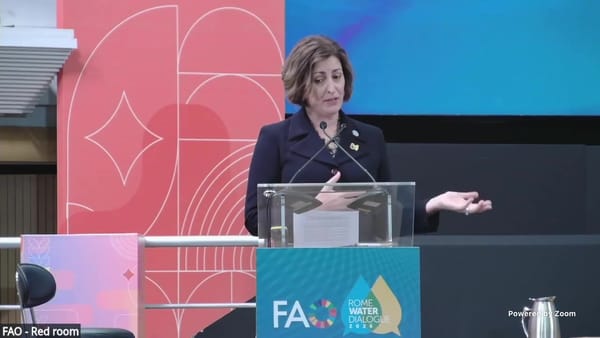
The launch closed the technical session on innovation, planning and investment in drought management and irrigation, the second day of the FAO Rome Water Dialogue 2026, in FAO's Red Room. The platform is the Mapping of Irrigation Potential and Needs initiative, IRMA.
Four questions, one index
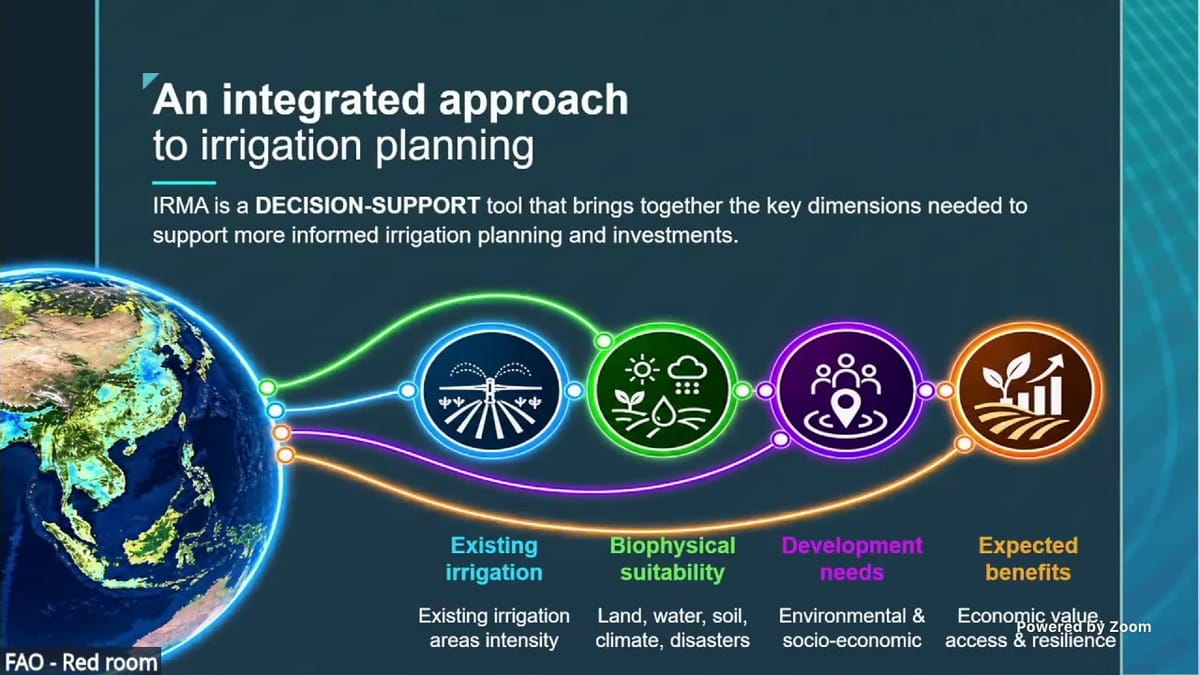
Stefania Giusti, Programme Officer in FAO's Land and Water Division, presented the platform. "Planning irrigation today does not simply mean infrastructure," she said. With pressure from climate variability, population growth and rising food demand, "deciding where to invest is a strategic choice, not just a technical calculation." IRMA is meant to answer the question "how do we decide where to invest?" by looking at four dimensions at once:
- existing irrigation: where irrigation exists today and how intensively it is used, mapped from satellite data, national expertise and machine learning;
- biophysical suitability: where irrigation is technically feasible, given surface and groundwater, soils, climate and disaster patterns;
- development needs: where irrigation is most needed, judged against environmental and socioeconomic conditions and national development objectives; and
- expected benefits: "where will it pay off", in productivity, economic viability and market access.
Combined into one index, the four dimensions classify areas by irrigation potential and show "the gap between what is irrigated today and where the investment should go".
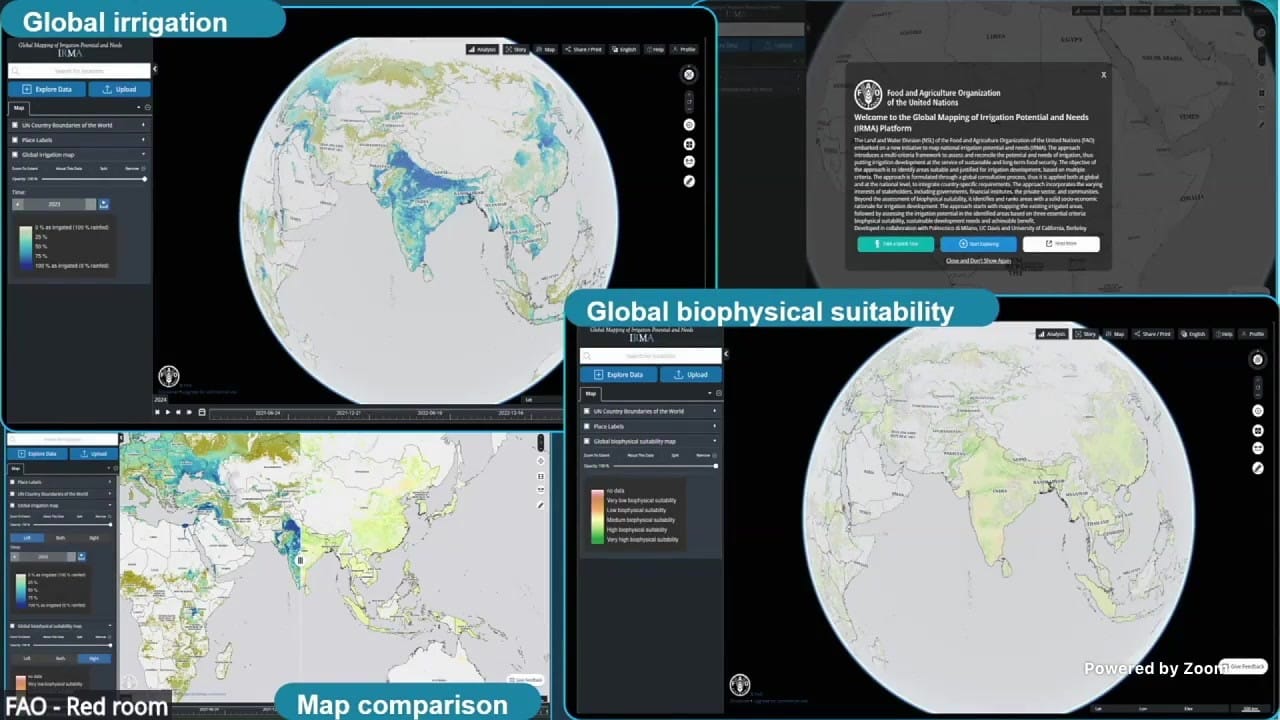
IRMA combines a common methodology and global data, which make results comparable, with national data and local expertise. At global level the platform is "freely accessible to all": it shows irrigated and rain-fed cropland and rates the suitability of farmland for irrigation in five classes, from very low to very high. Country platforms add high-resolution data on development needs and expected benefits, such as the value of irrigation water or high-value crop production. "IRMA is no longer just a methodology. It is live," Giusti said. It was developed with FAO's agro-informatics team under the Hand-in-Hand Initiative. Nora Berrahmouni, Deputy Director of FAO's Land and Water Division, who moderated, added a caution: "a platform is there but it needs to be used".
What the lenders said
The panel that followed was asked how irrigation investment can be increased and sustained, and how it can deliver more for farmers.
IFAD. Mendoza said about 20 per cent of IFAD's water-related investment goes directly to irrigation, mostly small-scale on-farm works, water harvesting and storage. Smallholders, he said, cannot be expected to recover capital costs, which is where blended finance comes in. His second point was governance, which matters for four reasons: access, so "that the smallholder farmers also benefit, not just the larger, better connected farmers"; sustainability, because communities with a stake maintain the system; land rights, because irrigation raises land values and with them the risk of disputes; and conflict, which is "better managed when there's a strong community-led governance". His one change: tools such as IRMA, because under fiscal pressure "we need to know how and where to invest".
Asian Development Bank. Narayan Iyer joked that he was "tempted to answer your question by saying we should use IRMA and then go home." More seriously, he said the aim should be to raise farmers' incomes "per unit volume of water, instead of looking at irrigated area", through better water delivery, governance and institutions.
Islamic Development Bank. Nizar Zaied said Islamic finance, an industry of about 3.4 trillion US dollars, suits irrigation because canals, dams and pumping stations are physical, asset-backed investments. He argued for rehabilitating existing schemes rather than always building new ones, since the economic return is "much, much higher", and said IsDB is working with FAO to apply IRMA in Senegal and Mauritania.
FAO Investment Centre. Giovanni Munoz said quality matters as much as quantity. The Centre's teams include "land tenure experts", among more than 20 specialties. Irrigation should be designed as a service supporting a value chain, starting from the market; schemes usually mix large, medium and small farmers; and modernising existing schemes should come before building new ones.
Two countries, two lessons
Azerbaijan. Shalala Hasanova said "efficiency on the farm does not automatically mean water saved in the basin": real savings depend on actual consumption, return flows and downstream users. About three-quarters of the country's irrigation canals are still earthen, and about half of irrigation water never reaches the field. Azerbaijan is reconstructing the Shirvan and Karabakh main canals, which together aim to cut losses by about 650 million cubic metres; the Shirvan canal alone will serve 228,000 hectares, 116,000 of them newly irrigated. "We will judge success not by kilometres of the concrete, but by reliable supply, productivity, energy use, and the benefits of the farmers."
China. Wang Yingchun of the Changjiang (Yangtze) Water Resources Commission answered in Chinese a question on how water is allocated among competing uses in the Yangtze basin. In his remarks as heard in the recording, he described the allocation of initial water rights on the basin's inter-provincial rivers, with water saving as the priority and ecological protection as a floor, setting "rigid boundaries" for each use. The commission has prepared water dispatch plans for 23 inter-provincial rivers, giving priority to domestic use, then basic ecological flows, then irrigation, industry and navigation. In the extreme droughts of 2022 and 2024, he said, coordinated operation of the basin's reservoirs protected drinking water first and water for crops at their critical growth stages.
The map and the rights on it
Closing the session, Lifeng Li, Director of FAO's Land and Water Division, gave four messages: irrigation is at the centre of drought management but "requires its own financing strategies"; finance for drought preparedness and irrigation exists, "but it must be better designed with data, with evidence ... and also structured in the way that will bring all the stakeholders together"; innovation, including IRMA, helps countries plan earlier and better; and resilience "is built long before the drought arrives". Drought will come, he said, and "whether it becomes a crisis or not, it's a choice that we make today."
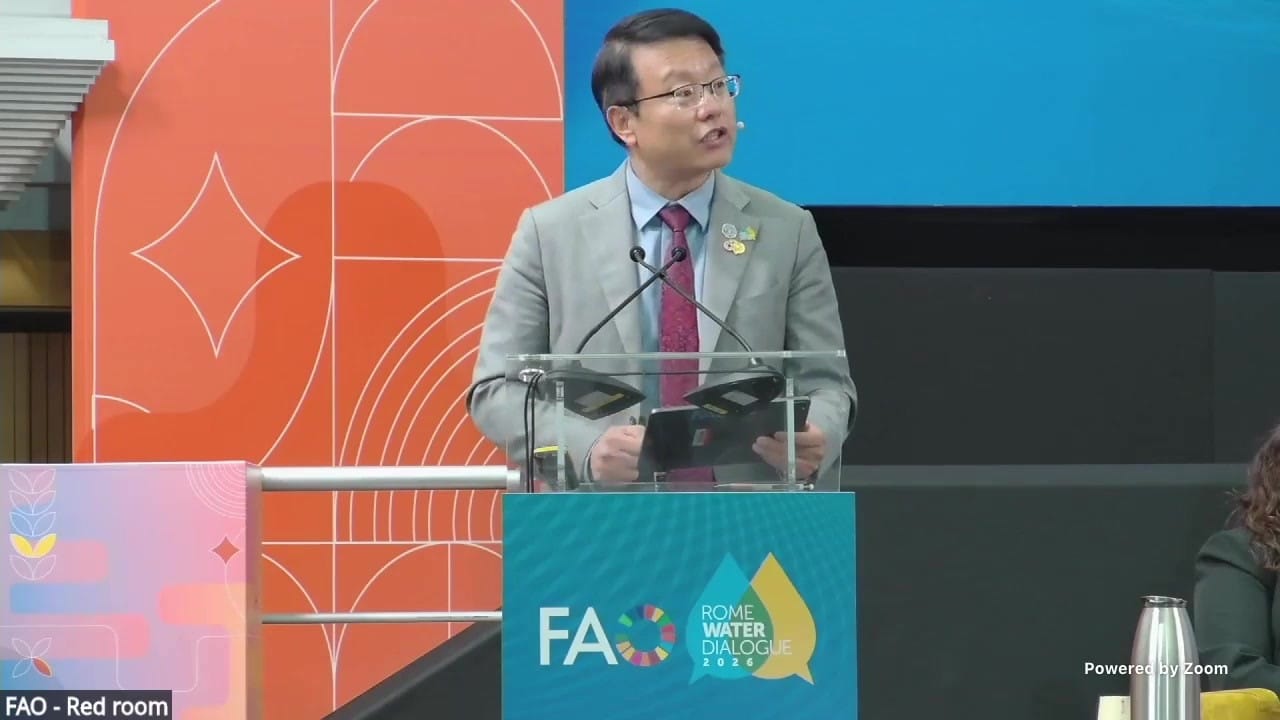
For CRPG, IRMA answers where irrigation is feasible and where it pays. It does not answer who already depends on that water and land, and on what terms. Mendoza's warning and Wang's account of rights-based allocation in the Yangtze point to the same complement: a tenure assessment of who uses the water, under which arrangements, before the investment arrives. In Indonesia, household wells that depend on canal seepage, farmers' informal arrangements and the "water mafia" that steers water in drought are exactly what a suitability map does not show. CRPG Director Mova Al'Afghani, PhD, made that case at the Dialogue's water tenure session (read our report: Making invisible water users visible).
The rest of the same session is covered in our reports on the ministerial panel and on the cost of unpreparedness and drought finance.
A note on sources. The UN has not published a transcript of this session. Quotations are taken from the session's English audio channel on UN Web TV, transcribed automatically by CRPG with Whisper, and lightly edited for false starts; omissions are marked with an ellipsis. Wang Yingchun's answer, given in Chinese, is summarised from the Chinese speech audible in the recording, in CRPG's own translation. If a UN transcript is published, the quotations will be checked against it and any change will be noted at the foot of this article. Images: ©FAO, stills from FAO's webcast of the session on UN Web TV.