'Will I get my water?': Stephen Hodgson presents the twelve draft principles for the responsible governance of water tenure
At the high-level Rome Water Dialogue, environmental lawyer Stephen Hodgson walked governments through FAO's twelve draft principles, arranged in a circle because 'there is no hierarchy' and 'the principles are completely interlinked'.

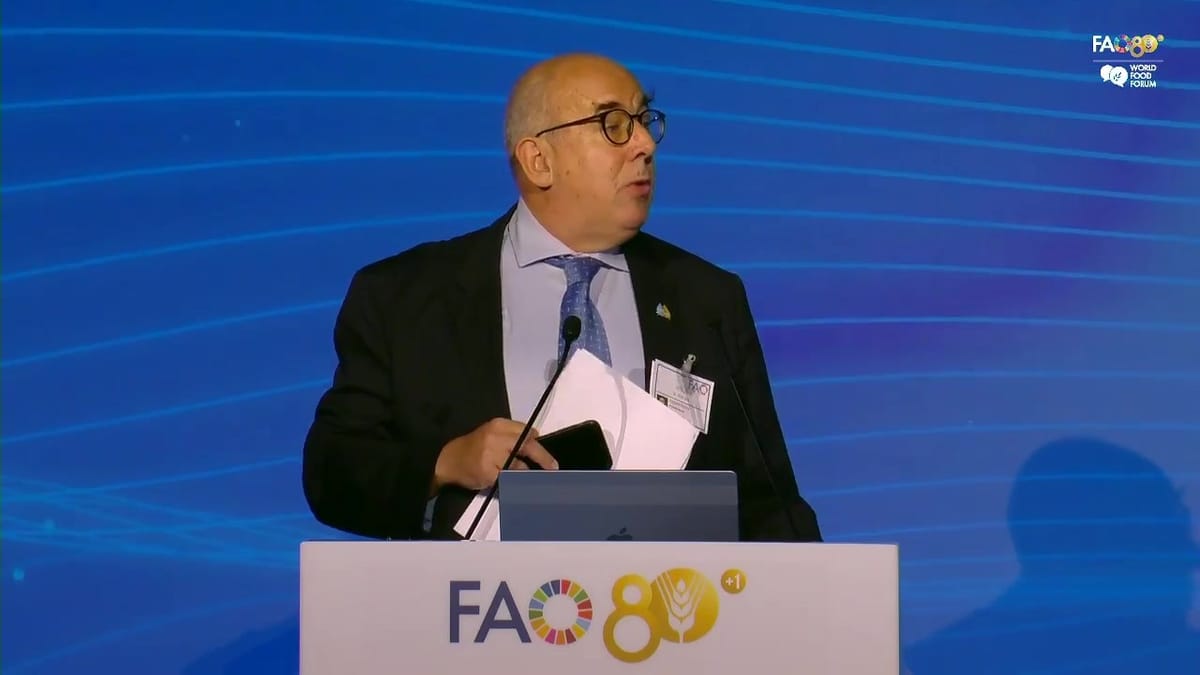
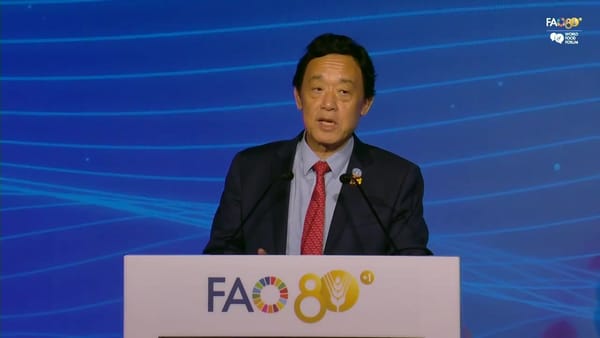
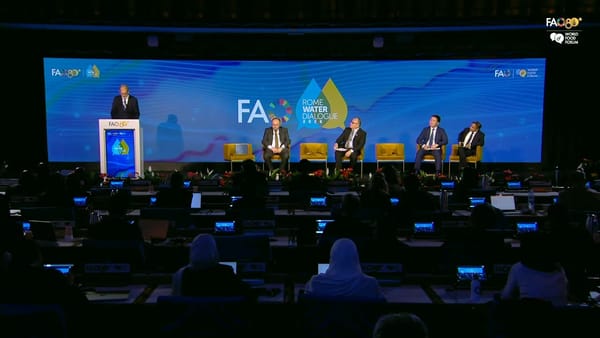
Rome, 14 October 2026. Before the ministers took the floor at the high-level session of the FAO Rome Water Dialogue 2026, the room heard what they were being asked to respond to. Stephen Hodgson, an international environmental lawyer and a member of FAO's Water Tenure Expert Group, presented the twelve draft principles for the responsible governance of water tenure. He started from the water user's point of view. "If you are a water user, if you are a farmer, if you are an irrigator, if you are a pastoralist, you need your water," he said. "That's all you care about in terms of water governance: will I get my water? Is my right to water secure?"
A circle, not a ladder
Hodgson opened with a slide that showed the twelve principles arranged in a circle, and explained why. "First of all, there is no hierarchy in these principles. Principle number one is as important as principle number 12," he said. "And second, the principles are completely interlinked. We cannot have secure water tenure without sustainability. We cannot have recognition and protection without accountability and transparency."
He also set out what water tenure is. "Water tenure describes our relationships with water resources, and in particular, the different means whereby water is allocated for use by different water users and different water sectors for different purposes," he said. Many arrangements derive from formal law, but "many others do not derive from formal law. They include customary arrangements, indigenous rights. They include arrangements that are not even recognised by law, like the rights of inland fishers to water."
The twelve principles, as presented
He then took the principles one by one, each on its own slide, in the order and with the numbers shown on his slides. The quotations are his.
- Recognition and protection. "Legitimate water tenure arrangements should be identified, recognised and protected. This is super important. Many people rely on informal arrangements." He was careful about the boundary: "Sometimes those arrangements are actually illegal. We are not talking about them. We are talking about arrangements that are informal, perhaps because the water law isn't fully implemented."
- Security of tenure. "This is absolutely key." It has two sides: legal security, "is my right, my entitlement, recognised in the law?", and practical security, "is the law actually properly implemented?" And: "secure water tenure is necessary for investment, economic activity and the protection of livelihoods."
- Rights-based approaches. "Water tenure arrangements must support these core rights that we all depend on," the human rights to water and food among them.
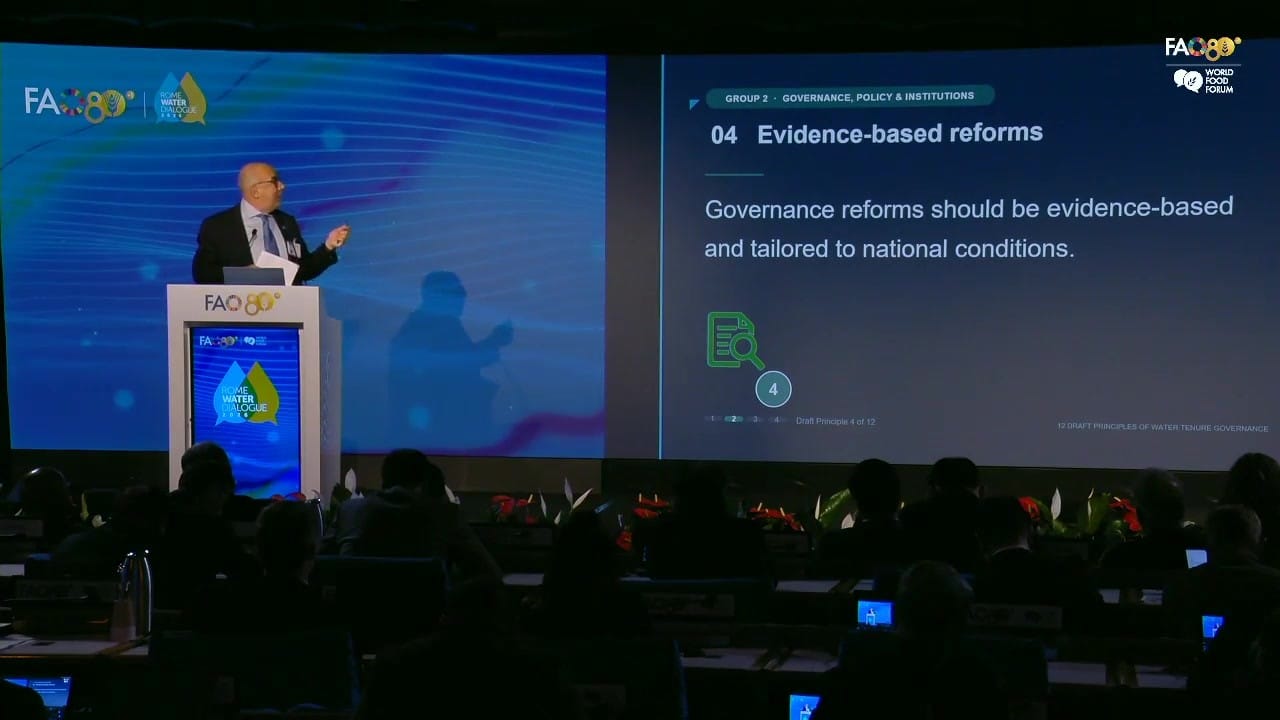
- Evidence-based reforms. "Unfortunately, there's a tendency in water laws to copy the neighbours. What did the neighbours do? We copy that. This is not a good approach." Instead, "the first step is: gather the evidence, water accounting evidence, of course, water tenure assessment. Understand the facts on the ground."
- Policy and legal coherence across water, land, environmental and fisheries legislation.
- Accountability and transparency: "Promote open, inclusive decision making, public participation, and oversight."
- Fair and inclusive water allocation, made "in a fair and accountable manner, based on robust data and water accounting. Again, water accounting. You can't manage what you don't know."
- Sustainability. "No point in talking about security if our environment is degraded." Human and ecological needs should be balanced, through the protection of wetlands and environmental flows.
- Resilience, which he called "a tricky one in the context of climate change. On the one hand, we want to give people long-term, secure water tenure rights so they can invest and build the economy. At the same time, though, the climate is changing. We might need to vary water allocation from year to year."
- Gender equality. "Many commitments to this. Let's make it real."
- Enforceability and accessibility. "Many countries struggle to implement their water laws." Sometimes the cause is a lack of financial and human resources, sometimes poorly designed systems. "Do people know what the requirements are? Do people know what their rights are?"
- Access to justice and dispute resolution. "If you have a water right, if you have secure water tenure, can you assert it? Can you assert it against the state? Can you assert it against other water users? Absolutely fundamental."
He closed where he began: "Back to our circle. Everything is completely interlinked."
Why the water user framing matters
Hodgson's opening question, "will I get my water?", is the one CRPG hears in the field in Indonesia. Water tenure assessments there keep finding users the formal system does not see: customary users, villagers who draw from wells along irrigation canals, community water systems without a permit. That was the theme of Monday's water tenure session, where CRPG Director Mova Al'Afghani, PhD, a member of the same Expert Group, spoke on the panel (read our report: Making invisible water users visible). For what happened when governments responded to the draft, see our report on the support from the high-level panels, and for the link between tenure security and investment, our report on ADB's intervention. For background, see the presentation of the draft principles on Monday and the CRPG knowledge base article on water tenure.
A note on sources. Hodgson spoke in English. His words are taken from the session's English audio channel, recorded and transcribed automatically by CRPG using Plaud, and lightly edited for false starts; the principles are still a draft and may change. They will be checked against the UN transcript of the session once it is published, and any change will be noted at the foot of this article. Images: ©FAO, stills from FAO's webcast of the session on UN Web TV, each matched to the timestamp of the words it accompanies.