Governance and investment belong together: clear water rights "determine whether investment works or not", says ADB
At the Rome Water Dialogue, ADB's Winfried Wicklein argued that clear rights, transparent allocation rules and capable institutions decide whether water investment works. FAO's draft element on tenure security makes the same link.

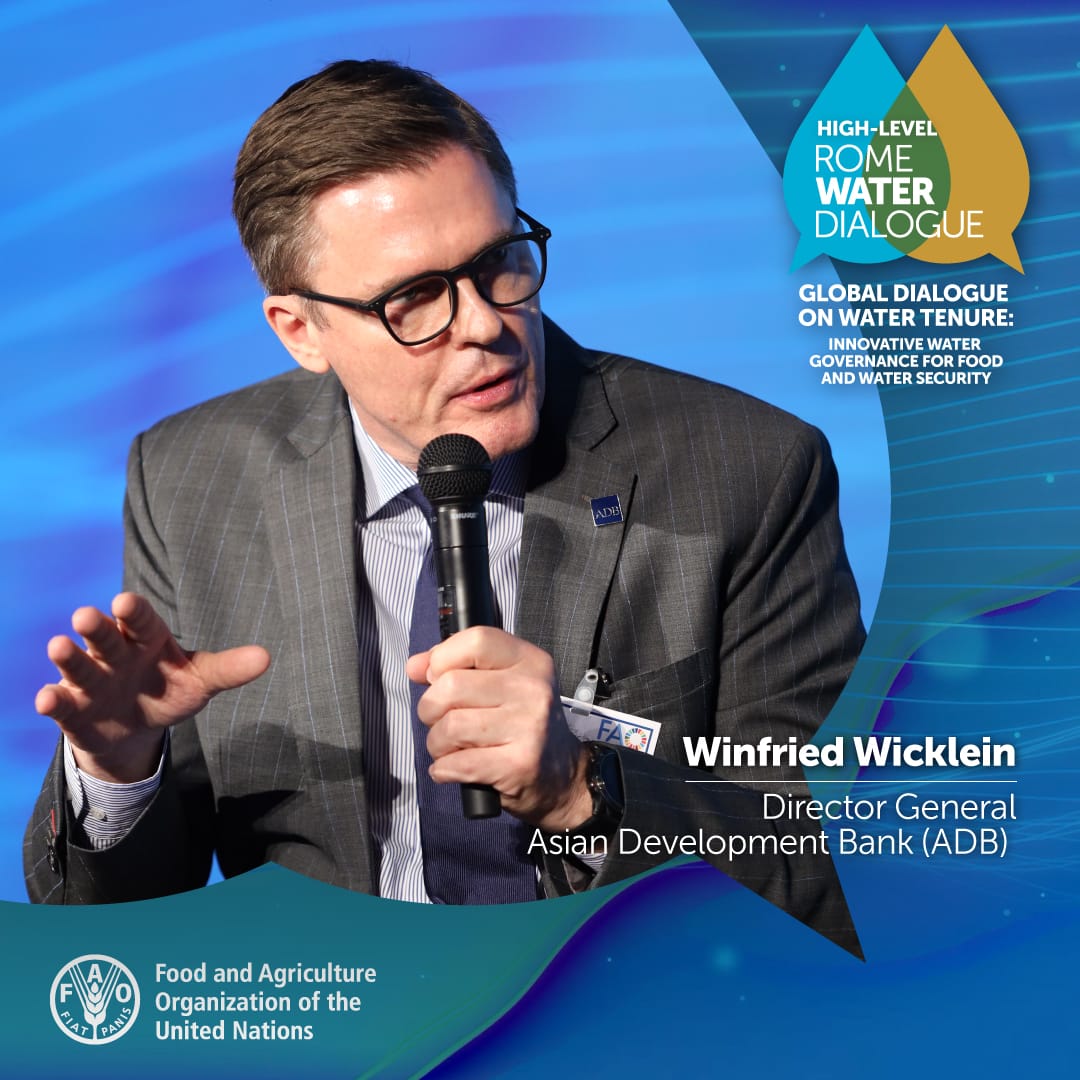
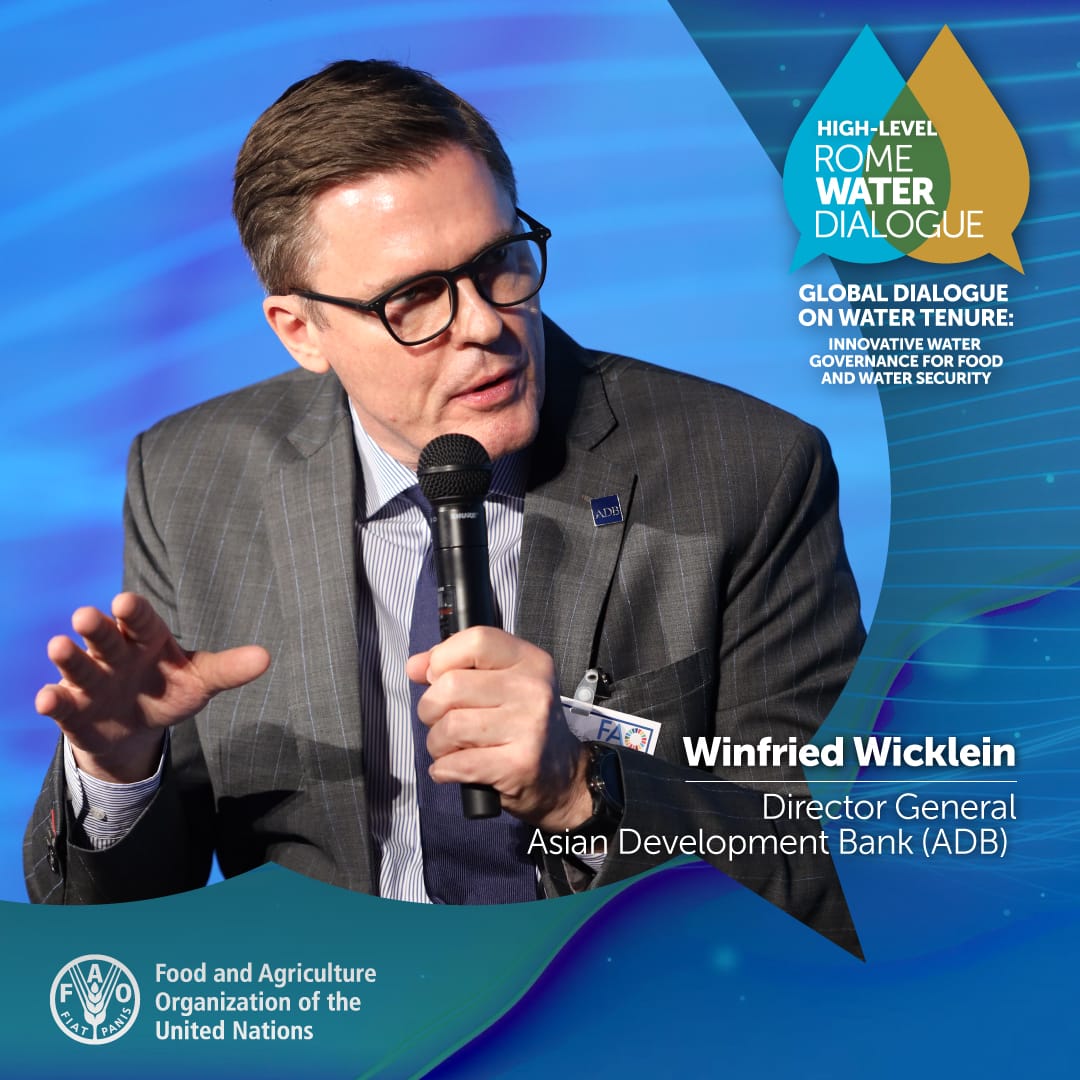
Rome, 14 October 2026. Talk about investment in water usually starts with dams, canals and treatment plants. At the high-level session of the FAO Rome Water Dialogue 2026, the Asian Development Bank put governance at the front instead. "Good governance and responsible investment belong together," said Winfried Wicklein, Director General of ADB's Sectors Department 2. "They are not separate."
The question put to the bank
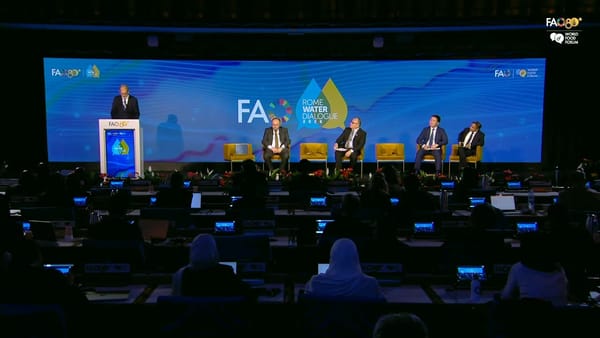
Wicklein spoke on the high-level panel, the second of the morning's two government panels on FAO's draft principles for the responsible governance of water tenure. His department runs ADB's operations in agriculture, food, nature and rural development, in water and urban development, and in digital. The moderator asked him how water access rights and equitable allocation connect to responsible investment in infrastructure, and what role multilateral development banks and other international financial institutions should play in strengthening water governance.
He answered in three points, speaking, as he put it, strictly from the perspective of a multilateral development bank working in Asia.
Governance decides whether investment works
The first point set the scene. Water security, Wicklein said, is increasingly an allocation and governance challenge. Water is becoming less predictable while demand keeps growing, so the question is who gets water, and for what purpose. "Tenure does matter," he said, and he welcomed "very much" the governance principles being prepared.
The second point is the one that gives this article its title. Governance and investment, Wicklein argued, must go together. On the governance side he named three things: "the clear rights, the transparent allocation rules, the capable institutions". These, he said, "determine whether investment works or not". For multilateral development banks this is fundamental, because it means their task is to help governments connect governance reforms with investment at scale.
The third point looked ahead. Wicklein called for a move from individual projects to water security at the scale of whole water systems, linking water, food and energy security with climate resilience and ecosystems, and combining governance, technology, investment and finance. He said ADB is consulting its developing member countries on a large new regional initiative along these lines, which it plans to launch around the middle of next year.
What the draft elements say about tenure security
Wicklein's second point lines up closely with one of the twelve draft elements of responsible water tenure governance that environmental lawyer Stephen Hodgson, a member of the Water Tenure Expert Group, presented earlier in the session. The element on security of water tenure asks for legal and administrative mechanisms that make water tenure arrangements secure enough to meet livelihood needs and support economic activity. In the same breath it ties that security to investment: such mechanisms should promote responsible investments based on reliable water accounting, and ensure that water is allocated and reallocated in an accountable and predictable way, especially in times of scarcity, while respecting all legitimate tenure arrangements.
Read together, the bank's argument and the draft element make the same claim from two directions. An investor needs to know that the water a project depends on will be there, and that the rules for sharing it will not change arbitrarily. The people who already use that water need to know that the project will not take it from them. Both are questions of tenure security. A related element, on enforceability and accessibility, adds that tenure governance needs practical measures for implementation, including adequate finance, and that permitting systems should not be so burdensome that ordinary users cannot get into them. For background on the concept itself, see the CRPG knowledge base article on water tenure.
What this means for investment in Indonesia
CRPG's water tenure work in Indonesia shows why the order matters. When an irrigation scheme, a hydropower plant or a bulk water supply project is designed on the basis of formal permits alone, it misses the users who hold no permit: customary users, villagers who draw from wells along the canals, community water systems. Those users still depend on the water, and when an investment cuts them off, the result is conflict, complaints and, increasingly, legal and reputational risk for the financier (see: A permit is not consent). A water tenure assessment, done before the investment decision, makes those users visible. That was the theme of Monday's water tenure session, where CRPG Director Mova Al'Afghani, PhD, spoke on the panel (read our report: Making invisible water users visible).
Tuesday's session on drought and irrigation finance made a similar point from the planning side, with FAO's launch of IRMA, a platform for mapping where irrigation is feasible and where it pays. Wicklein's intervention completes the picture: the maps and the money only work if the rights underneath them are clear.
A note on sources. Wicklein's remarks are taken from CRPG's audio recording of the panel in the Plenary Hall, transcribed automatically by the Plaud recorder; quotations are lightly edited for false starts, and they have since been checked against the session's English audio channel, also transcribed automatically by Plaud. They will be checked again against the UN transcript of the session once it is published. FAO's own summary, posted by FAO Land, Soil and Water on X, matches the point in our title: "Capable institutions determine whether investments in responsible water governance of #WaterTenure work." The description of the draft elements follows FAO's draft text circulated for the dialogue; the elements are still a draft and may change. The programme and later recordings are on the event page. For the rest of Wednesday's session, see our report on Türkiye's statement on Gaza.
Correction, 14 October 2026, 17:20 CEST. After publication, CRPG checked Wicklein's remarks against the session's English audio channel. Previously, this article said he named four things on the governance side: "clear rights, transparency, allocation rules and capable institutions". He named three: "the clear rights, the transparent allocation rules, the capable institutions". The opening quotation previously read "Governance and responsible investment belong together … They're not separate"; the clearer audio has "Good governance and responsible investment belong together … They are not separate." The article also previously said he welcomed principles "presented that morning"; he referred to principles being prepared. It also said that his panel closed the morning's discussion; a stakeholder panel followed it. The excerpt has been updated.