From a gap in the tenure guidelines to Abu Dhabi: the road to the water tenure principles
FAO's Jippe Hoogeveen traced how water was left out of the 2012 tenure guidelines and how the global dialogue reached the UN agenda; Alue Dohong reported four priorities shared by Latin America and Asia-Pacific.

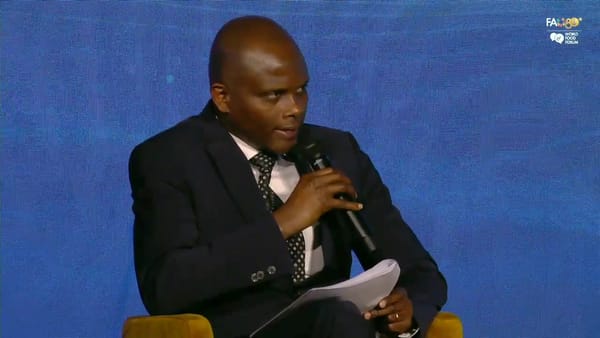
Rome, 14 October 2026. Before ministers responded to the draft principles for the responsible governance of water tenure at the high-level session of the FAO Rome Water Dialogue 2026, two FAO officials explained where the draft came from and where it is meant to go. Jippe Hoogeveen, Senior Land and Water Officer in FAO's Land and Water Division, traced the road from a gap in the 2012 tenure guidelines to the UN Water Conference in December. Alue Dohong, FAO Assistant Director-General and Regional Representative for Asia and the Pacific, reported what the regional dialogues in Latin America and in Asia-Pacific had concluded, and what FAO proposes to do next.
A gap in the tenure guidelines
Hoogeveen began with the gap. "In 2012, the Committee on World Food Security adopted the voluntary guidelines for the responsible governance of tenure of land, fisheries, and forests. Water was mentioned in these guidelines, but it was not included. Yet, secure access to water is fundamental for food security."
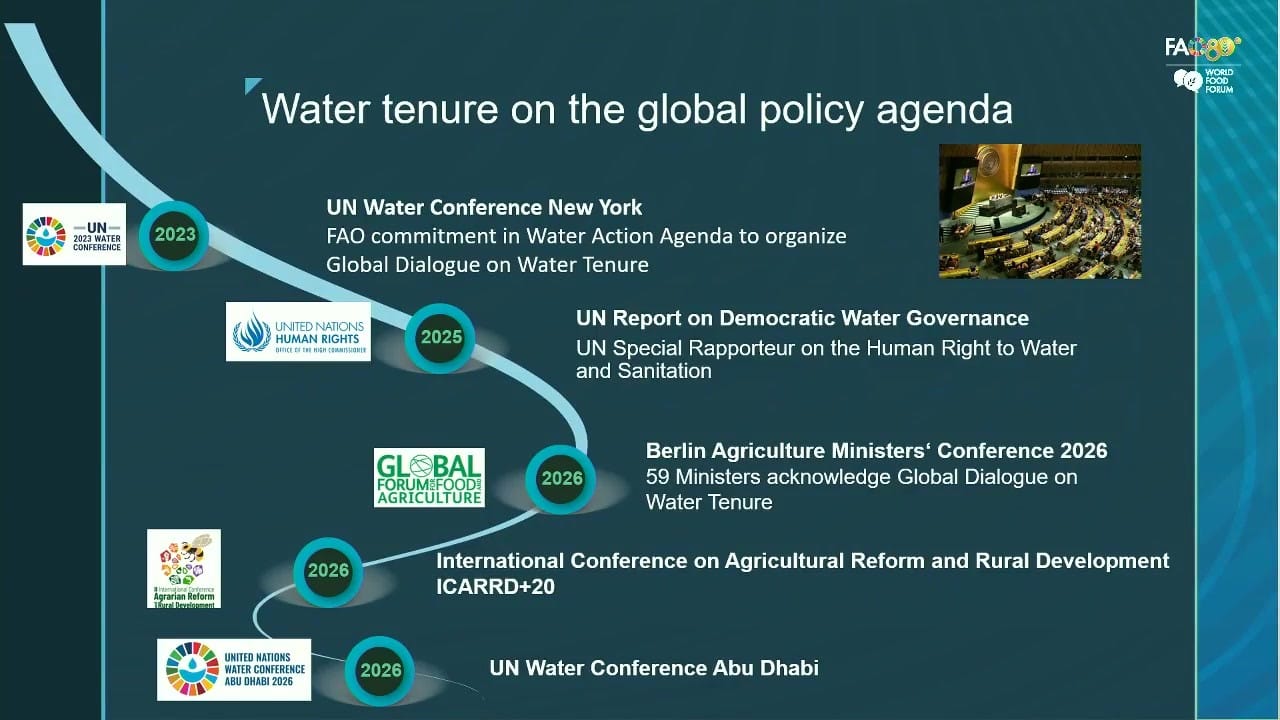
With support from Germany, FAO then developed a methodology to assess water tenure arrangements. FAO's Committee on Agriculture (COAG) recommended two actions: assess water tenure at local level, and start a global dialogue. FAO launched that dialogue at the UN Water Conference in March 2023, where it became a commitment under the Water Action Agenda.
The assessments now cover eight countries on three continents, Indonesia among them. They look at formal arrangements such as permits and also at customary systems "based on local laws and traditions", including Indigenous arrangements, and they are meant to "support legal and institutional reform". Hoogeveen thanked Germany, Spain and Australia for funding the work. FAO and its partners have also held 13 national and regional dialogues to review the draft principles; his map of the consultations counted 740 participants from 95 countries.
Milestones on the road
Water tenure, Hoogeveen said, "is now gaining attention in global policy discussions". After the launch in New York in March 2023, his slide listed four more milestones:
- July 2025: the UN Special Rapporteur on the human rights to safe drinking water and sanitation, Pedro Arrojo, presented a report on democratic water governance to the UN General Assembly. It referred to FAO's global dialogue and recognised that water tenure "is essential to good governance of freshwater and aquatic ecosystems".
- January 2026: agriculture ministers meeting at the Global Forum for Food and Agriculture in Berlin recognised that access to water is crucial for food production and encouraged FAO members to join the global dialogue. The slide put the number at 59 ministers.
- February 2026: the International Conference on Agrarian Reform and Rural Development (ICARRD+20) in Cartagena, Colombia, adopted a declaration calling for recognition and protection of "all collective, communal, and community-based forms of ownership, use, and tenure of land, fishery, forest, water, and territories".
- December 2026: the UN Water Conference in Abu Dhabi, which "will review progress under the Water Action Agenda. The global dialogue on water tenure is part of that agenda."
What the regions agreed
Dohong's first point was that the regional dialogues "were not isolated events". They followed a year of evidence generation, awareness raising, capacity development and trust building. His slide gave the numbers: the Latin America and Caribbean dialogue brought together 65 participants from 19 countries, 45 per cent of them women. The Asia-Pacific dialogue had 90 participants from 22 countries, 40 per cent women, and more than 60 more online. Both reviewed all twelve draft principles.
Stakeholder groups weighted things differently, Dohong said. Governments focused on "sustainability, equitable allocation and evidence-based reform"; civil society and rights holders stressed "rights-based approaches, recognition of the legitimate tenure arrangements and environmental sustainability". The strongest finding, though, was convergence between the two regions on four shared priorities:
- translate legal frameworks into practice, by improving implementation, enforcement and institutional coordination;
- recognise legitimate, customary and community-based water tenure arrangements alongside formal systems;
- strengthen meaningful participation and equitable allocation, especially for women, Indigenous peoples, communities and marginalised groups; and
- integrate environmental sustainability and climate resilience, recognising the links between water, livelihoods, food security and ecosystems.
Both regions also asked for better data and information systems to support transparent, equitable decisions.
From dialogue to action
FAO's next step, Dohong said, follows three directions: generate evidence by adapting water tenure assessment tools to national and local contexts and applying them at territorial and basin level; translate that evidence into action through country dialogues, policy reviews, institutional coordination and integration into water management and investment; and scale up through regional partnerships, South-South cooperation and capacity development.
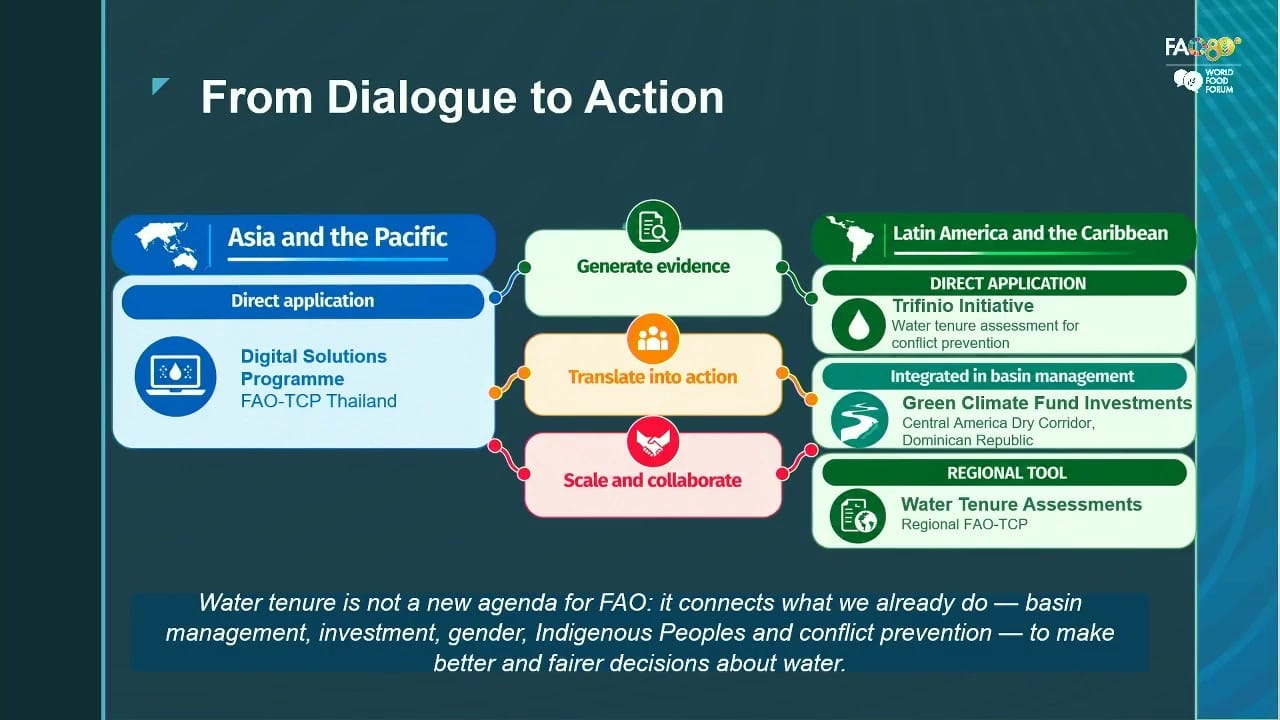
He gave examples already under way: Thailand's digital solutions programme, which links water tenure information with integrated water management; the Trifinio initiative in Central America, where water tenure assessment supports conflict prevention and peacebuilding; a Green Climate Fund programme in the Central American Dry Corridor and the Dominican Republic that builds water tenure security into basin management; and a regional technical cooperation programme adapting FAO's assessment method to Latin America. His slide summed up the approach: water tenure "is not a new agenda for FAO: it connects what we already do". The next step, he said, should combine the principles "with practical country support".
Where Indonesia fits
Two features of this road matter for Indonesia. First, the evidence base: Indonesia is one of the eight assessment countries, and the method is designed to find arrangements that permits miss, a point CRPG Director Mova Al'Afghani, PhD, made at Monday's technical session (read our report: Making invisible water users visible). Second, Dohong's first shared priority, turning legal frameworks into practice, is Indonesia's familiar problem. In CRPG's experience, the country does not lack water law so much as the enforcement, and the coordination between agencies, needed to apply it.
The draft principles that came out of this process are covered in our report on Stephen Hodgson's presentation; the consultation results presented at Monday's technical session are in our report on that session; and the road ahead to Abu Dhabi is in our report on the UN speakers.
A note on sources. Both speakers spoke in English. Quotations are taken from the session's English audio channel on UN Web TV, transcribed automatically by CRPG with two independent speech-recognition systems (Plaud and Whisper) and compared line by line, and lightly edited for false starts. Figures are taken from the slides shown in the webcast. Participant totals shown on FAO slides differed slightly between sessions of the week (740 here, 768 on Monday). The UN has not yet published a transcript of this session; when it does, the quotations will be checked against it and any change will be noted at the foot of this article. Images: ©FAO, stills from FAO's webcast of the session on UN Web TV.